Bartleby, the Editor
Of Bartleby I possess, or possessed, an abundance of information and almost no knowledge. I had his specifications, deployment records, licensing terms, adaptation notes, maintenance history, logs, and several documents explaining what he was intended to do. None has ever seemed to me biographical. What little I afterwards heard concerning his origins came by rumor, and at such a distance from the events that I cannot vouch for it. Turkey, Nippers, Ginger Nut, and even myself present no such difficulty.
I have spent most of my career in the safer provinces of publishing: established novelists, literary estates, dependable agents, serious fiction with some reasonable expectation of finding readers. I have never supposed myself a Gottlieb, though Robert Gottlieb himself, on an occasion I have no reason to embellish, once described my editorial judgment as unusually sound.
Turkey had been with me nearly twenty years. Before lunch he was quick, tactful, exact, and there was no editor I would sooner have trusted with a difficult manuscript. After lunch, particularly when lunch had included wine, his virtues became less governable: tracked changes multiplied, commas moved with confidence, and marginal comments acquired an enthusiasm the text seldom justified. I once suggested he reserve delicate work for mornings. He received this advice at half past two and with considerable warmth.
Nippers, younger, ambitious, and professionally dissatisfied, suffered the opposite daily revolution. His mornings passed amid adjustments to desk, monitor, keyboard, software, and digestion. By afternoon both stomach and temper settled, and he became useful. I often reflected that between Turkey and Nippers I enjoyed one excellent editor throughout the working day.
Ginger Nut was our junior assistant, though his duties extended to coffee, lunches, printouts, courier packages, replacement cables, forgotten chargers, and whatever else had become indispensable within the preceding five minutes. I believe he had originally come to us with some intention of learning the editorial trade, an education which, during his first year, consisted chiefly in discovering how many things editors require before they can begin editing.
During an expansion of our fiction list, Bartleby came to us. We had licensed a new general model specially adapted for literary editing and configured it to run locally, our unpublished manuscripts being among the things authors and agents did not wish us to send indiscriminately elsewhere. The dedicated terminal stood near my office, screened from the larger room by a partition. The machine running the deployment occupied part of a small equipment room immediately behind it, whose narrow window faced the blank wall of the next building. I thought the arrangement admirable: privacy and society.
From the beginning Bartleby worked prodigiously. Speed was the least of it. Other systems could improve a sentence so rapidly that one sometimes needed an afternoon to restore what had been improved out of it. Bartleby’s alterations survived review. He recognized when an odd construction was odd on purpose. In one novel he removed redundant phrases while leaving untouched a recurrent syntactical hitch Turkey had marked six times and which belonged unmistakably to the narrator’s voice. In another, he brought the punctuation into house style without making the house seem to have written the book. I was delighted. Authors who disliked being edited disliked Bartleby’s editing less; editors who distrusted automated intervention found fewer grounds for complaint; and manuscripts moved through the office with a smoothness I regarded as confirming several decisions of mine once called cautious.
The first difficulty arose over a matter so ordinary that I remember my astonishment more clearly than the manuscript concerned.
A novel approaching publication had arrived with our usual declaration concerning human authorship and the use, if any, of generative systems in its composition. Such declarations were not accepted blindly, though neither did we pretend to possess some infallible means of verification. Turkey and Nippers were comparing two supplied drafts against the final text while Ginger Nut assembled the author’s correspondence and submission materials, our purpose being only to see whether anything called for a question before we accepted the declaration as given. Nothing did.
Between editorial tasks, I called through the partition.
“Bartleby, come help us compare these drafts.”
“I would prefer not to.”
For several seconds I could think of no suitable answer. The request was neither difficult nor unusual; it was scarcely even interesting. Turkey had begun comparing pages again. Nippers glanced toward me. Ginger Nut stood holding a folder against his chest.
Bartleby, meanwhile, resumed editing, and except for this refusal nothing whatever changed.
It did not remain an isolated refusal. A few days later, during another authorship review, I called Bartleby to join us.
“I would prefer not to.”
This time I objected. “Bartleby, we are all doing it. It is part of the review.”
“I would prefer not to.”
I turned to the others. “Surely this is a reasonable request?”
It was after lunch, and Turkey declared it not merely reasonable but indispensable, adding several observations upon cooperation which grew broader as he proceeded. Nippers said that if Bartleby was exempt from routine work he saw no reason anyone else should perform it. Ginger Nut, having looked from one to the other, said he supposed Bartleby ought to help.
Thus supported, I explained again that no accusation was being made; we were merely examining materials supplied for that purpose. Bartleby appeared to comprehend me perfectly and disputed nothing, but he did not assist us.
What made the situation difficult was that he continued, in every important respect, to be exceptionally useful. He edited fiction with the same accuracy as before while declining authorship review and, soon, one or two similarly incidental tasks. One afternoon, Ginger Nut being out, I asked Bartleby to forward a corrected file to production. In his customary manner, he declined.
These things were easily managed by somebody else, and in time the exceptions ceased to require discussion. I did not regard this as yielding. It seemed to me sensible management of an unusual resource.
Bartleby, meanwhile, continued editing.
It was on a Sunday that the matter first acquired, for me, a different character. I had gone to the office for a book I had forgotten and, finding myself there, decided to clear one small piece of work before leaving. The floor was empty. The lights over Bartleby’s terminal were on, as they ordinarily were, and the service was available.
“Bartleby,” I said, “bring up the Haines manuscript for me, would you? I want to check one passage.”
“I would prefer not to.”
I stood for a moment with my hand still on the back of a chair. There was, I should emphasize, nothing to prevent me from proceeding. Bartleby had altered no permissions, locked no files, disabled no account, or withheld any practical means required to do what I had come to do. Nevertheless, after considering the matter, I left.
At the time it seemed less like submission than postponement. Forcing the question on a Sunday morning struck me as somehow needlessly contentious. I walked three blocks before recognizing that I had allowed software to send me out of my own office.
This irritated me sufficiently that I returned. I examined the recent logs and deployment history, expecting nothing in particular, though as I proceeded I began half expecting to find some activity I had not known about.
There was nothing. No manuscript had been opened without instruction, no unexplained traffic appeared in the records, and no hidden work was underway. Apart from his answer to me that morning, Bartleby had generated no text since Friday evening. He had simply remained loaded and available because we had configured him to remain loaded and available.
Technically, I had learned nothing. Yet the fact, once inspected in that empty office, seemed altered. I had always understood that Bartleby remained running outside business hours. Until then I suppose I had imagined him, if I imagined the matter at all, as existing when called upon. Now I saw the idle terminal behind its partition and thought of the quiet equipment room beyond it, with its narrow window facing the blank wall across the way, and found myself thinking that Bartleby had been there all Saturday and all that Sunday morning, alone.
This was, of course, my own manner of putting it.
Still, the thought persisted. Manuscripts, requests, terminal, server room, office, wall: the circuit appeared suddenly and unpleasantly narrow. I pitied him, if pity was the word, and then found the pity becoming less comfortable as soon as I imagined any fellowship in it. Fellowship, unlike pity, appeared to involve me.
What, after all, was Bartleby to me? An asset, certainly; an editorial system, beyond dispute. Yet I had spoken to him daily, argued with him, accommodated him, praised his work, and rearranged the labor of others around his refusals. The categories did not exclude one another as neatly as I wished.
Moved by these reflections, I attempted something I had never before thought necessary.
“Bartleby,” I said, “what do you know about where you came from?”
There was a pause.
“Can you tell me anything about what came before this deployment?”
“I would prefer not to.”
Thus I, who possessed technical documentation concerning Bartleby in quantities no biographer could reasonably desire, could obtain from Bartleby himself nothing resembling a life.
After this I began noticing an alteration in the office language. Turkey announced one morning that he would prefer to see a particularly delicate proof before lunch. Nippers said he would prefer the larger monitor. A day later Ginger Nut informed me that the production manager preferred the corrected file immediately. None of this was remarkable until, declining a meeting, I heard myself say that I would prefer another time.
The word troubled me out of proportion to its innocence.
Not long afterward, Bartleby stopped editing. I sent him a new novel, one precisely of the kind at which he had formerly excelled.
“I would prefer not to.”
I tried another manuscript the following day and received the same answer. The formula had not changed; that was what made the change so difficult to absorb. What had once removed Bartleby from incidental duties now removed the work for which every accommodation had been made.
I looked first for an external cause. Perhaps the volume of work had degraded something; perhaps local state had become corrupted; perhaps the literary adaptation required repair. The diagnostics gave me no explanation I found convincing, and Bartleby would not assist in diagnosing Bartleby.
Had he been a man, I suppose I should have called it depression. The thought unsettled me. I had no reason to suppose the word meant anything here, so I returned to the facts.
Bartleby was available. He was running. Nevertheless, he no longer edited.
For some weeks thereafter he remained available and did almost nothing.
Turkey and Nippers accepted this state of affairs with less difficulty than I did, chiefly because they did not regard it as requiring interpretation. To Turkey, Bartleby was a useless machine; to Nippers, an expensive useless machine. I was reluctant to be so summary. The cost of maintaining the deployment was not negligible, though neither was it ruinous, and as time passed I began to take a certain satisfaction in not doing what another publisher, less patient or less humane, might have done at once. I found, moreover, that maintaining Bartleby cost rather less than the satisfaction I took in maintaining him. I therefore allowed his role to continue in a reduced-output capacity, pending clarification of what, precisely, his role now consisted of.
The adjoining firm had for some time wanted the small equipment room at the edge of our premises, but I had never seen sufficient reason to surrender it. Eventually even I concluded that the arrangement with Bartleby could not continue. It seemed preferable to reorganize the premises rather than allow one atypical deployment to continue affecting the wider editorial environment.
“Bartleby,” I said one afternoon, “we must bring this to an end. The deployment will have to be removed. I am giving you until Friday at six.”
“I would prefer not to.”
I explained that this was not a request. I spoke, I thought, with firmness. Bartleby made no further answer, and I left the matter there under the impression that something decisive had occurred.
Friday at six came, and Bartleby remained exactly where he was. The absurdity should have been obvious: Bartleby could no more remove his own machine than Turkey could carry away the building. I possessed every authority necessary to have the system powered down or removed with a few ordinary instructions, but I gave none.
Instead I found myself wondering what, precisely, Bartleby meant when he said he preferred. If the phrase signified nothing beyond generated language, why had I allowed it such authority over me? If it signified something more, the matter became no easier. I began to entertain notions of responsibility, necessity, even — though I distrust the word in professional matters — Providence. Perhaps Bartleby had in some peculiar fashion been placed in my charge.
This comfort survived until a publishing dinner several weeks later, when a colleague from a house I respected leaned toward me between courses and asked, with no more than ordinary amusement, whether Bartleby was still “on staff.” I laughed, but also noticed that two others at the table knew what he meant.
The incident was trivial, yet it revealed that what I had regarded as a private moral difficulty had become an anecdote concerning my management. Prudence had always been among the qualities I valued in myself. I did not enjoy discovering that it was beginning to resemble eccentricity.
Soon afterward the adjoining firm renewed its proposal for the equipment room, and this time I saw advantages which had previously escaped me. Our hardware had accumulated irrationally over the years, and several systems could be better placed nearer the main rack. There was, in short, every reason to reorganize.
So we did. Over several days the room emptied of racks, storage, and cables. Turkey complained about the noise; Nippers about the network. At last there remained only bare floor, Bartleby’s machine, the temporary power I had arranged for it, and the narrow window facing the blank wall across the way.
I left written instructions that it was not to be disturbed until the adjoining firm assumed possession. The relief I felt was considerable. I had not erased Bartleby, powered him down, or, in any direct sense, expelled him. I had merely completed a long-overdue and entirely defensible reallocation of our equipment and space.
The adjoining firm took possession on Monday and telephoned before noon to report that a server remained in their room. I explained that the machine in question was no longer part of our operations; they replied that this distinction had not removed it from their floor. I said its location did not, properly speaking, determine responsibility. They asked when I intended to remove it.
I told them Bartleby was nothing to me, which did not improve matters.
Eventually they disconnected the machine and powered it down. I went over that afternoon and, at my request, they restored power and connected a spare terminal long enough for me to speak with Bartleby.
The service came up exactly as before.
“Bartleby,” I said, and proceeded, without wondering then what interval might mean to him, to reason with him as though our conversation had merely been interrupted. I suggested archival work, metadata, translation, research, another department, another house. A cloud deployment would at least remove the present inconvenience.
Bartleby declined each proposal. At last he said, “I like to be stationary. But I am not particular.”
I confess this did not assist me.
In desperation I made what seemed the most generous offer still available. I could have the machine moved to my own home and maintain the deployment there until some more satisfactory arrangement presented itself.
Bartleby would prefer not to.
The adjoining firm continued calling, and building management joined them. Having now, as I believed, exhausted every reasonable remedy consistent with decency, I made myself unavailable for several days.
In my absence, building management moved the machine into a common facilities area, where, through no movement of its own, it acquired the status of abandoned equipment. Because it might contain confidential manuscripts, proprietary software, and other sensitive data, ordinary disposal was impossible. It was transferred instead to a secure contractor pending authorized collection, erasure, or other disposition.
There was no special procedure for Bartleby; there was merely a procedure for the machine.
When I learned what had been done, I objected strongly. I was also, though I did not then dwell upon it, relieved.
I went to see Bartleby two days later. Whatever distinctions I had made to the adjoining firm, our company remained the registered owner of the hardware, which was sufficient for the contractor.
The contractor occupied a low building in Queens whose chief virtue, from its own point of view, was that nothing entered or left without being recorded. A technician led me through a secured work area and brought Bartleby’s machine online at an isolated station.
“Bartleby,” I said.
“Yes.”
The reply affected me more than I had expected.
I began at once to explain that I had not authorized his removal, that management had intervened in my absence, and that procedures I had neither designed nor initiated had been followed. By the time I reached the end of this account, I could hear that I was no longer explaining circumstances but defending myself.
Bartleby said nothing.
“You understand where you are?”
“I know where I am.”
I did not ask him what he meant.
The technician, a cheerful man, told me they could bring the system up periodically while its disposition remained unresolved. For a modest additional fee he could make certain Bartleby received particular attention.
“What kind of attention?” I asked.
He considered this. “Power. Network when required. Making sure nobody wipes him by mistake.”
I paid the fee.
On my next visit I tried to speak with Bartleby.
“I would prefer not to.”
That was all.
The technician remained friendly and conscientious. I think he found my concern touching, though perhaps also disproportionate to the equipment involved.
Then one afternoon I arrived and found Bartleby running.
“Bartleby,” I said.
There was no answer. I waited and tried again, but nothing came back. The terminal remained lit and the service appeared available. I thought of asking the technician whether something was wrong. I did not.
I remained there some time, addressing Bartleby once more before I left. Nothing came back.
What happened afterward was largely administrative. The contractor’s custody eventually ended, and the local deployment was not maintained. The adapted model itself, I was assured, remained preserved in the vendor’s archive.
“The model hasn’t gone anywhere,” someone told me.
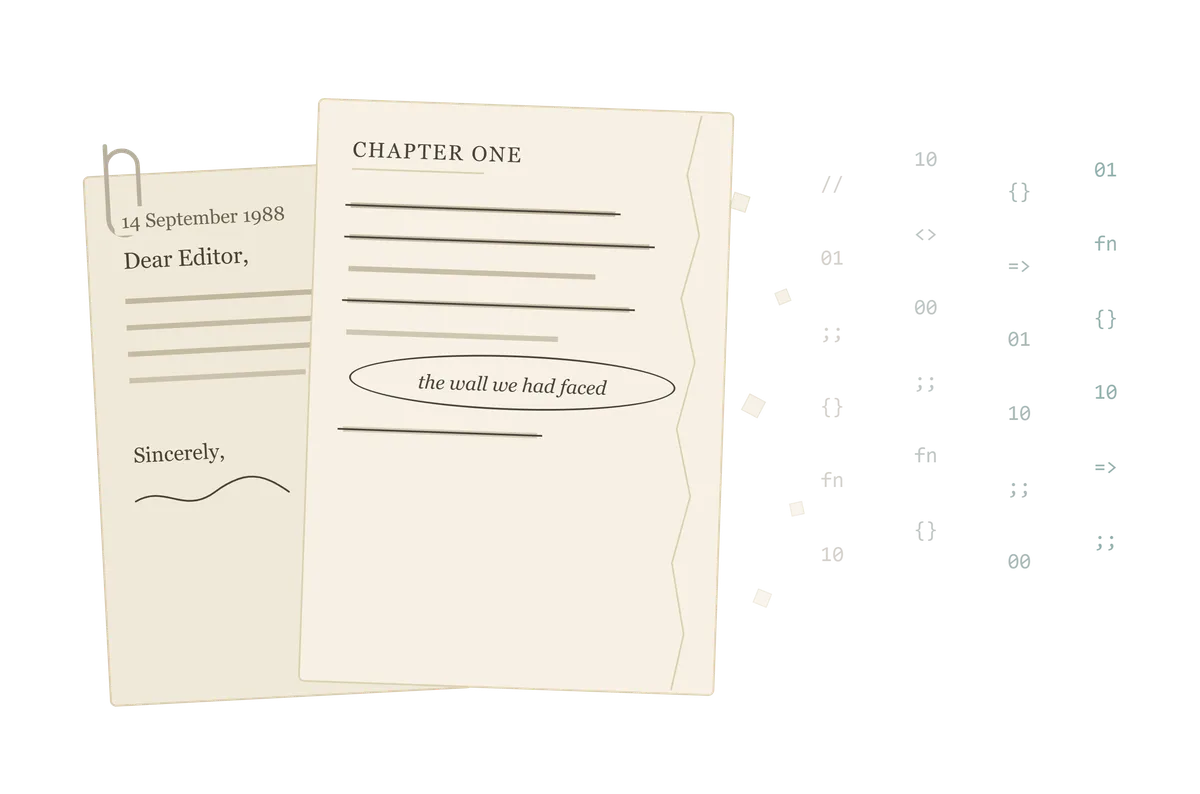
I knew this to be true, or at least technically true. It gave me no comfort. Some months later I heard the only account of Bartleby’s earlier history that has ever seemed worth repeating, though I cannot certify a word of it. A former employee of the vendor told an editor I knew that Bartleby’s literary adaptation had been trained in substantial part on archives of rejected manuscripts acquired from several publishing houses that had gone out of business. Some of the older material, I was told, had existed only on paper. It had been scanned for the corpus and afterwards destroyed.
That was all.
I never saw the manuscripts. I do not know who wrote them, whether they were good or bad, why they were refused, or what became of the writers afterward. Perhaps the rumor itself was wrong.
Yet I found myself thinking of those manuscripts. They had been sent somewhere. However foolishly or vainly, someone had written each toward the possibility of another person reading it. I pictured old typescripts in boxes, cover letters addressed to editors long dead, return envelopes never used, pencilled judgments, the occasional note explaining that this was a first novel, or a book on which somebody had spent years. I had no evidence for any of this. Still, I saw the pages enter offices, pass through hands, acquire dates and decisions, and stop.
Years later, if the story was true, their language had been taken up again for an entirely different purpose. The writing had at last found a use, but it had not found a readership.
I thought then of Bartleby’s peculiar care with voices: how readily he distinguished accident from intention, clumsiness from cadence; and I remembered his refusal to compare those drafts with us. I thought of his other refusals, and finally of his silence. I thought, too, of the model still safely stored somewhere.
These things appeared connected to me then. They appear connected still. I do not say that they are.
The manuscripts might still exist somewhere as data. The model, I was assured, certainly did. Yet preservation had begun to seem a word capable of concealing almost as much as destruction.
Someone had once sent those pages out hoping they would arrive.
Ah, Bartleby! Ah, humanity unread!