Heart of Blankness
I sat low on the sled, knees locked under the lashings, as if the whole arrangement were designed less for travel than for keeping a man from standing up and objecting. The runners hissed over hard snow with a thin, continuous sound, like paper being filed. The cold did not so much bite as administer: a clean, persistent pressure that turned breath into evidence and thought into a checklist. Ahead, the Manager leaned forward and peered into the white as if he expected the interior to produce a record.
The Greenland Free State had the air of stationery mistaken for sovereignty: a Charter sanctified by the Board of Peace and executed, in practice, by the Company, whose Freedom City gleamed on the coast far behind us with glass, slogans, and armed friendliness. The phrase “freedom and innovation” did the moral work that used to require sermons. Out here, where ice replaced the glass, it amounted to permission.
He’s out of position, the Manager said, and fixed his eyes on the white ahead as if the interior were an audit that would eventually surrender its discrepancies.
The dogs pulled; the runners kept up their thin, continuous hiss. Nothing in that level whiteness offered itself as a landmark, and yet the whole arrangement — Charter, Board, Company — felt to me like a landmark of another sort: a smooth legal surface laid over something hard, on which intentions could travel a long way without leaving the kind of track that shames a man later.
A speck darkened the distance, then resolved into a man moving toward us with the loose, confident gait of someone who had made private terms with the cold. Behind him the white gave up the Inner Station in pieces: a low black building, a drill tower, a tracked snowcat, a shipping container skewed on the strip, and the microreactor in its casing with cables laid over the snow like veins. The Manager lifted his chin a fraction. The man raised an arm in greeting, and I had the uneasy sense that we were about to hear Kurtz spoken into existence by a voice that did not understand what it was saying.
The figure on the ice waved us in with an inviting energy, as if he had been waiting for company rather than for consequence. The Manager straightened and stabbed a gloved hand back toward the freight sled, where the lashings held our Inuit driver and the runner showed a fresh, ugly break. “Drone attack!” he shouted. “I know, I know,” the man called back in a breathless Russian accent, cheerful as you please. “He doesn’t like visitors. It’s all right. Come along, good. I’m glad.”
He came up close then, laughing under his breath as if we had arrived for a party, and I saw that his bright cheer had been assembled, like the rest of him, out of whatever would hold. He was dressed in expensive outdoor gear repaired past dignity, sponsor logos half scoured away: Palantir on one sleeve, a16z on the other. His face was beardless and boyish, and he had the restless urgency of someone who had been alone too long and was determined to talk his way back into the world.
“You’re here for him. For Kurtz. Good. Good. You’re in time.” He said the name with a kind of quick warmth that embarrassed me on his behalf and did not embarrass him at all. “You can’t understand what it’s like to be near someone like that. You don’t talk with him. You listen.”
The Manager tried to cut through him. “We’re taking him back.”
The boy’s smile faltered, returned, faltered again. “Yes, yes. Back. The recall.” He brightened with the violence of someone refusing a thought. “But first you have to see what he’s done. It’s real. It works. It’s freedom and innovation, the way they talk about it on the coast.”
He jerked his chin inland. “He drills through the sheet. Straight down. He finds what’s there and he takes it. Rare earths, under ice. He does not wait for anyone. He does not ask. He hates waiting. He says waiting makes you a slave.” He stopped, blinked hard, and rushed on. “It’s not even the digging that matters. It’s the power.”
“The power?” I said.
His face lit with pride that was almost tender. “The microreactor,” he said, lowering his voice. “He had it brought in. No dependence on Freedom City.” He laughed, delighted, then checked himself. “There were leaks. Not at first. Then a little. Then more. The shielding got compromised. He wouldn’t shut it down.” The cheer drained out of him for a moment. “He’s been sick. Very sick.” He glanced past me toward the interior, then back again, eager and pleading at once. “But it’s all right. He’s a great man. He’s… a next-level human. That’s what he says. Come along, good.”
They brought him out on a stretcher with the brisk care reserved for a difficult object, four staff members at the handles and a couple of security men walking close with rifles held in the ready way that pretends not to be ready. Kurtz lay long upon the canvas, taller than I had expected, and wasted in a manner that made height look like a mistake. When his head lifted, it was as if some remaining principle in him insisted on being seen.
He raised one hand, scarcely more than a gesture, and the escort obeyed it at once. The rifles went down. The men stepped away and waited at a distance, as if they had been dismissed from a room.
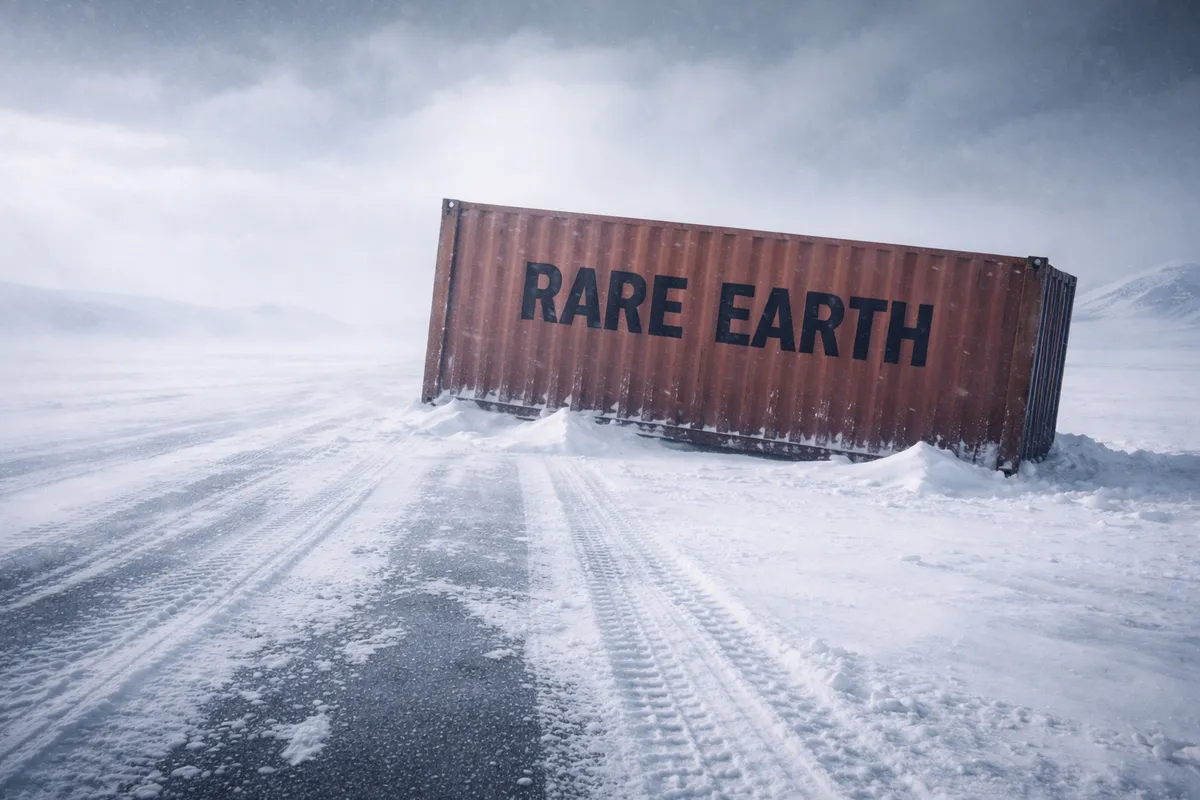
The Manager had come up to the microreactor first, drawn by it as a man is drawn by the source of trouble. He examined it with an expression that tried, and failed, to become disgust. A warning placard clung to the casing; the shielding showed a patch that looked recent and insufficient. He turned from that to the airstrip and stood looking at the crude obstruction dragged across it, a shipping container skewed in the snow with RARE EARTH stenciled on the side in hard black letters. He stared, as if taking an inventory of deliberate inconveniences, and then muttered, not to me and not to Kurtz, “This operation isn’t scalable.”
“I’ll get it to scale yet. I will return,” Kurtz said.
He paused, as if listening for applause that would not come this far inland. Then, with a sudden impatience that sounded almost like strength, he said, “I had immense plans.”
His gaze moved past me toward the blank interior, and his mouth shaped the next words with childish certainty. “Presidents at spaceports.”
He let that hang there, pleased with it, and then his hand groped at the blanket near his ribs. A folded printout appeared, creased and kept close, and he pressed it into my mitten with a small, furtive urgency, the gesture itself the last form of control.
“Give it to my Intended,” he said. “She will know what to do with it.” Then the satisfaction slipped away. His eyes went past us, past the men waiting with their rifles lowered, past the reactor and the crooked container on the strip, and fixed themselves on the white that began where all arrangements ended.
It happened without any signal. He twisted with a sudden impatience that did not belong to his body, and the blanket and the canvas gave him nothing to hold. The stretcher tilted; he rolled off it and landed on the snow with a dull, soft thud. One of the staff half-started forward, then stopped, as if touch required authorization.
Kurtz lay on his side a second, gathering himself, and then began to move. He did not get up. He dragged his long frame forward with his forearms, as though the legs were no longer part of the contract. The snow took him without resistance. He was going, in his own mind, not away from us but back to something that had been calling him long before we arrived.
I followed.
Behind me I heard a low stir, a restrained murmur, and then nothing; the others remained where they were, waiting, obeying the hesitation that was itself a kind of obedience. Ahead there was only the white, level and absolute, the interior reduced to a surface, and the man crawling toward it as if toward a promise.
When I came up to him, he had stopped. His mouth opened once, wide, as if he wanted to take in that frigid void and make it his again. The words came out thinly, not spoken so much as exhaled, and yet they carried.
“The emptiness!” he whispered. His jaw worked, and the whisper rose, broke, and rose again. “The emptiness!”
He gave a small shudder, as though something inside him had finally let go of its hold, and his head sank into the snow.
On the way back the dogs settled into their work with a steadiness that made everything human feel optional. The sled ran, the white held, and the wind did its careful, impersonal accounting along the seams of my clothing. Kurtz lay behind us now as a fact already filed. The Manager sat forward, silent in the manner of a man whose anxieties have become recoverable losses. I had the folded printout inside my parka where it would not tear, and I took it out from time to time, not from curiosity exactly, but from that old weakness of mine for looking at the thing itself when everyone else prefers the story.
It was addressed to the International Commission for Humane Optimization, and I gathered that this body had entrusted Kurtz with a report for its future guidance. He had written it too. I read it as the sled hissed on, and the words did their work.
It was not long, but it was dense. There were headings, certainly, and an orderly numbering that suggested a mind in love with order. Yet nothing in it was susceptible to proof. It began from a familiar elevation and spoke down from it with calm sincerity.
Humanity, it said, had reached a point of development at which those best positioned to innovate must necessarily appear to the rest in the nature of something higher than human. Not gods, the report hastened to clarify, but stewards. Not tyrants, but optimizers. It spoke of “freedom and innovation” as though they were forces of nature rather than slogans, to be harnessed like wind or current and admired for it.
By the simple exercise of will, aided by capital, computation, and the necessary surveillance, it claimed one could exert a power for good practically unbounded. It rose from there, and I rose with it against my better judgment. It made a picture of an Immensity managed at last. The Commission’s style was pious without faith, scientific without measurement. There were no practical hints to interrupt the current. No mention of bodies, hunger, or cold. Only “systems,” “alignment,” “telemetry,” “biosignals,” and the benevolent pressure of enhancement. Here and there, a phrase flared up with that special heat words acquire when they are used to spare men the trouble of feeling anything.
Kurtz’s eloquence still had the power to make one tingle with a kind of involuntary assent. The sentences went forward like a procession. It was all optimization, all uplift, all humane inevitability. It asked, in effect, that you admire the intention so much you would cease to notice what would have to be done to carry it out.
At the bottom of the last page there was a note, scrawled in a hand that had lost its patience with form. It was not part of the Commission’s approved language. It did not bother to optimize itself. It stood there like a flare struck in a clean room.
“Exterminate all the brutes!”
I stared at the word, and understood at once that “brutes” did not mean savages, nor enemies, nor criminals, nor rebels. It meant the mass. The redundant. The unoptimized remainder. The people who were not going to fit into the beautiful headings, who could not be made efficient enough to justify their own continued existence.
The sled ran on. The wind found my eyes, and the page trembled in my mitten as if it were alive.
I tore off the postscript and crumpled it into a tight ball, feeling its small, ugly solidity while I walked through the warm, glassy corridors of Freedom City.
Her office was high and clean, a room arranged for affirmation. Along one wall a display rotated through holo-portraits, each face appearing with a soft, tasteful insistence and then dissolving into the next: Elon Musk, Peter Thiel, Marc Andreessen. On the desk, where a sensible person might have kept a paperweight, there stood a small golden statuette of the President in his official aspect, smiling in metal as if smiling were a form of law.
She did not look as if she had been mourning in silence. She looked as if she had been waiting for a deliverable. When I set the printout down she put her hand on it, not tenderly, but possessively, as though it were a certificate. “You were with him,” she said, and it was not quite a question. “To the end.” “To the end,” I answered.
Her eyes fixed on my mouth with the same certainty I had seen before in other places, in other faces, whenever a finality was expected. “What did he say?” she asked. “His last words. I need to know. I need something to live with.” For a moment I felt the ball of paper in my left hand as if it were hot. I heard myself answer, because in that room the question was already shaping the reply.
“The last thing he said was — Elon’s name.”
The sound she made was not a sob exactly. It was a breath of recognition, of relief. Her face brightened with a kind of exultation that was almost religious. “I knew it,” she whispered. “I knew he didn’t go rogue. He believed in the Mission to the end.”
She was already going live. Her posture changed by a degree and became public. The office, the portraits, the little gold President, all of it aligned itself around that rectangle of light. She looked into it with wet eyes and perfect composure, and began, at once, to give Kurtz back to the world as a saintly philanthropist, a genius explorer, a man of freedom and innovation who had given his life for humanity. Her followers were waiting.
I stood there long enough to see her face lit from below by the upload glow, earnest, radiant, already certain of its own reception. Then I turned away. In the corridor outside I opened my left hand. The crumpled page sat there, small and ridiculous, the whole of it reduced to a wad. I shrugged, as one shrugs at an unpleasant scrap that cannot be filed, and dropped it into the wastebasket by the door.
Outside, under the overcast sky, the still visible sled tracks seemed to lead back into the heart of an immense blankness.