How Much Space Does a Civilization Need?
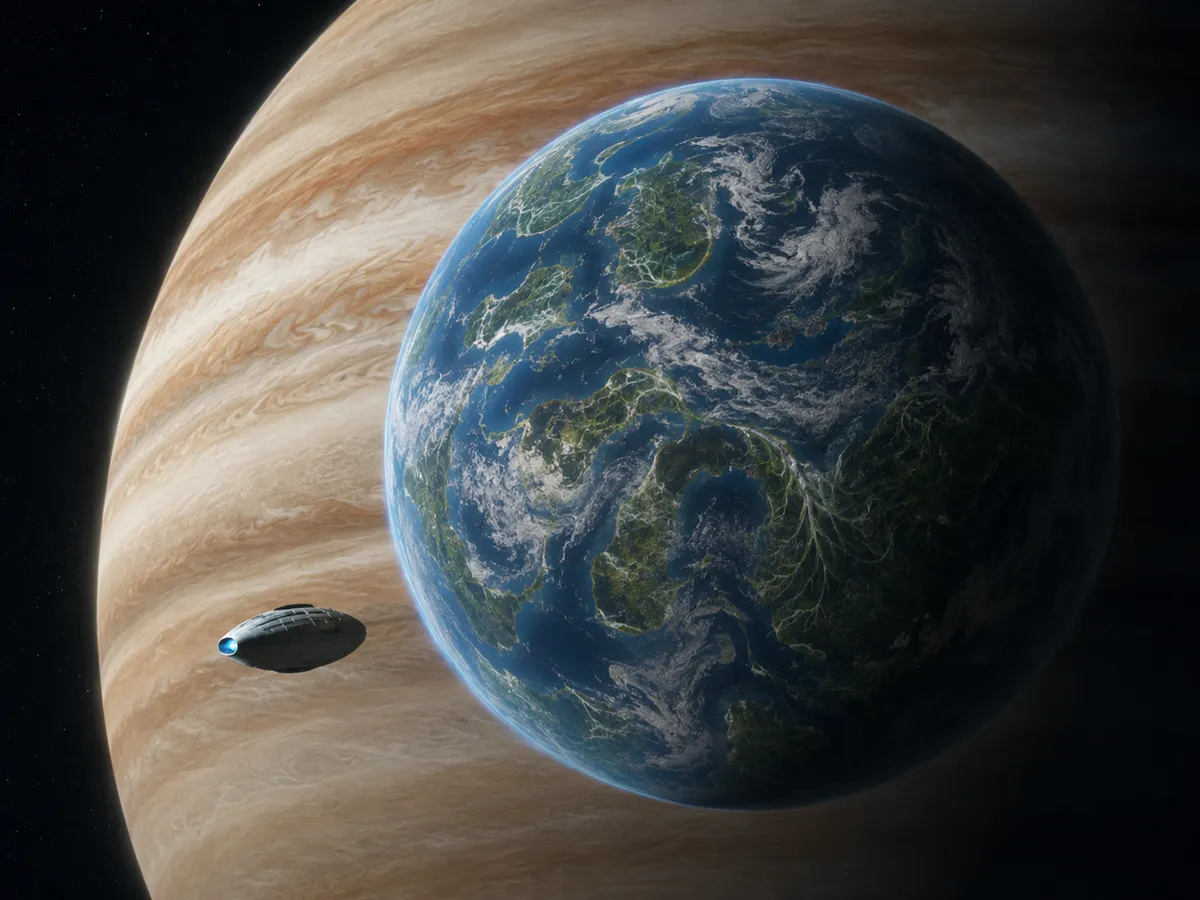
In 2095 the human race could travel through space, but Earth was still its only home. There were stations on the Moon, expeditions to the planets, and machines farther out. But there was no place beyond Earth from which civilization could begin again if Earth were lost.
That year an alien vessel was approaching the Solar System. It was still far from Earth, but messages had already crossed the distance between them, and enough had been learned to make the old distances seem smaller. A public debate on human expansion was carried live around the world.
One of the speakers was an expert in planetary security and interstellar planning. She said that humanity remained a civilization with a single point of failure.
“A sufficiently great disaster,” she said, “could destroy not only those now living, but everything mankind has preserved and made. Until now we have treated interstellar distance as protection. The visitors have shown us that it is not.”
She argued that humanity needed other worlds, far enough apart that no single disaster could reach them all.
Another speaker was an authority on resilient systems. She agreed that civilization needed redundancy, but said redundancy was not the same thing as continual expansion.
“A system survives because it has reserves,” she said. “It keeps capacity unused. It preserves choices. If every new resource becomes a reason to enlarge the system, then enlargement itself consumes the margin meant to protect it.”
The first speaker answered that unused territory could also be a reserve. The visitors, according to what little humanity knew, possessed an immense number of stellar systems, many of which they did not appear to use. Surely there could be no harm in asking whether some might be made available.
At that moment the broadcast was interrupted. The World Union president appeared. His mouth was set, but his eyes shone as he began to read.
During the exchanges with the approaching vessel, the World Union had already put the question to the visitors.
And they had already answered.
II
The president said that the visitors came from an ancient civilization near the Galactic Centre. Their home system circled the great black hole at the centre of the galaxy once every hundred Earth years. To them, that was a day. They possessed more stellar territory than humanity could easily comprehend, and among them there was an old custom.
If another civilization wished for territory, it might have whatever stellar systems fell within a circuit made by one of its representatives, as measured on the visitors’ standard map of the galactic disk. For the purposes of the claim, the circuit would begin and end at a fixed point about one hundred thousand kilometres above the landing ground, where local planetary flight gave way to interstellar flight. The claimant would depart outward through that point and return through it on the approach to the place from which he had set out. He had to travel personally, and the circuit had to be completed within one of the visitors’ days: one hundred years.
Everything inside the completed boundary would belong to the claimant’s civilization.
There was a price: one cubic metre of living earth.
The World Union did not accept at once. The answer passed through committees, broadcasts, assemblies and courts. Some opposed the bargain altogether. Others said that, if humanity accepted it, the route must be fixed beforehand and the claimant must not be free to enlarge it merely because something desirable happened to lie within reach.
In the end humanity accepted.
The alien carrier reached Earth five years later and came down on the Bashkir steppe. It was so vast that the human launch complex beside it looked provisional, almost toy-like. It was to remain there until the claimant completed the circuit, while communication with its crew took place remotely, their exchanges rendered into human languages by machines.
People soon began calling the visitors Bashkirians.
They had brought with them a smaller vessel intended for such claims, and during the remaining years of their approach they adapted it to human physiology and human controls. Though “smaller” was only relative: it too dwarfed the structures around the landing ground. Where human interstellar craft relied on a miniature sun, its engines were powered by a miniature black hole, and it could carry a pilot through space at nearly nine-tenths the speed of light.
The human being chosen was a man named Pahom. He was thirty years old, the son of agricultural workers, and had spent most of his adult life preparing for difficult missions. He was intelligent, technically exact and slow to take unnecessary risks. These were among the chief reasons he had been chosen.
The Bashkirians explained their rule carefully. Pahom himself had to make the circuit. The vessel could calculate routes, maintain its systems, execute his commands and preserve his life. But whenever a significant navigational maneuver was required, Pahom had to authorize it consciously, in real time, when the maneuver was about to be made. No such decision could be made for him or authorized beforehand. Only the claimant could alter the course once the circuit began.
The distances gave the rule its force. Once Pahom was light-years from Earth, advice from home would always arrive too late.
Before his departure the price was delivered. The cubic metre had been cut whole from living ground. Grass remained on its upper surface. Fine roots showed along the dark sides, and within the soil were seeds, worms, fungi and countless smaller living things.
Pahom looked at the exposed sides longer than most of the officials did. It was good soil, dark through most of its depth, held together by roots and moisture. He had been trained to command vessels, but he still knew the look of earth that would take seed.
It was sealed and given to the Bashkirians. No one asked what they intended to do with it.
At the departure ceremony Pahom said, “Give mankind enough worlds and no single disaster could destroy it.”
III
The route embodied the compromise. Its boundary was settled before Pahom left, and its schedule contained a substantial margin for error. Pahom could alter it only if new information materially changed the assumptions on which it had been designed, and only if the vessel certified that the altered route still permitted completion within the hundred-year limit.
The planners had deliberately left Alpha Centauri outside. Many people thought this absurd. Humanity’s nearest stellar neighbor seemed the obvious first possession. But its known terrestrial planet appeared a poor place for settlement, and the planners would not enlarge a century-long journey merely because the system was famous and close.
That, they said, was precisely the kind of temptation a safety margin was meant to resist.
The planned journey would take about ninety-two years, leaving eight years in reserve. The margin allowed the vessel to begin its final approach conservatively, to slow well before reaching Earth, and to absorb sickness, error, damage, delay, and all the things a plan cannot foresee. Some thought the boundary too small. Others thought the whole undertaking too large. Those who supported the compromise called it the minimum defensible claim: enough territory to give humanity genuine strategic depth without consuming the whole margin that made the claim safe.
In the year 2100 Pahom crossed the launch ground on the Bashkir steppe, with the immense alien carrier rising beside it, and entered the vessel prepared for him. The route had been calculated and the boundary fixed. The ship rose from the steppe and climbed away from Earth under local lift until it reached the agreed starting point, about one hundred thousand kilometres above the planet.
There local planetary flight ended and the interstellar circuit began. Pahom authorized the first maneuver.
The ship began its journey through the stars.
IV
Early in the outward journey Pahom passed close enough to Alpha Centauri for the Bashkirian instruments to examine its known terrestrial planet at much closer range than had ever been possible from Earth. For decades it had been considered marginal: useful perhaps for science or industry, but a poor place for a permanent settlement.
The new observations changed that judgment. True, the planet was no second Earth. Its atmosphere could not be breathed without assistance, and any first settlement would depend on machinery and specialist supplies from home. But it had water, broad regions of usable land, tolerable temperatures and manageable gravity. Its climate was steadier than expected, its surface less hostile, and accessible resources more plentiful. A human colony established there could endure and grow.
Pahom compared the observations with the criteria under which the route had been fixed. Alpha Centauri had been deliberately excluded because its planet was thought unable to support a substantial settlement. The Bashkirian instruments had shown that assumption to be wrong.
There was no time to ask Earth. By the time his report reached Earth and an answer returned, Alpha Centauri would be far behind him.
Pahom calculated a new course which would bring Alpha Centauri inside the circuit. The alteration was modest, but it would cost time. He would also have to travel somewhat faster on the next leg.
The vessel examined the route and displayed its judgment:
COMPLETION FEASIBLE.
Projected completion: year ninety-four.
It meant only that, on the information available, the altered route could still be completed within the hundred years.
The revised journey would take about ninety-four years. Six years of the original margin remained. The return profile would be somewhat tighter than before, but there was still ample time for a gradual approach and for delays that could not be predicted.
Pahom authorized the maneuver.
Years later his report reached Earth. Mission Control reviewed the observations and approved what he had done. The agreed restraint, it told him, did not require obedience to assumptions which new evidence had disproved. The revised route remained well within the margin established for unforeseen circumstances.
Its message referred to the planet as humanity’s first threshold beyond the Solar System. The phrase was repeated in public broadcasts, and before long the planet itself was simply called Threshold.
Pahom received the message much later. He had made the decision alone, and Earth had told him he had been right.
V
Much later, on the middle leg of the journey, Pahom approached GJ 588. Human astronomers had long suspected that several planets circled the star, but nothing known about the system had made it seem especially valuable.
The Bashkirian instruments showed otherwise.
No single planet was remarkable. One temperate world had oceans, broad areas of land and a climate within human tolerances, but its atmosphere could not be breathed. Elsewhere in the system were smaller planets and bodies rich in metals, water, carbon compounds and the other materials needed for construction and industry.
A sufficiently equipped human population could settle GJ 588 and thereafter live without further help from Earth. It could produce food, build machinery, replace what wore out and obtain the raw materials needed for continued growth.
Threshold could support a colony. GJ 588 could support a civilization capable of continuing if Earth itself were lost.
Again there was no time to ask Earth. By the time a reply returned, the choice would be history.
He calculated a new course.
This diversion was more costly than the first. To bring GJ 588 inside the boundary, the vessel would have to travel at about four-fifths the speed of light for much of the next leg. It would also have to remain at high speed longer, leaving less time near the end of the journey for delay or recovery.
The navigation system checked the route.
COMPLETION FEASIBLE.
Projected completion: year ninety-seven.
Pahom considered that for a long time. Three years was much less than eight, and only half what had remained after Threshold. But the margin still existed, and the vessel still certified the route.
Here was a system capable of preserving civilization itself.
To leave it outside now seemed less like restraint than a failure to carry out the purpose of the mission.
Pahom authorized the maneuver and sent his report to Earth.
Years later Mission Control received his report and approved the decision. A settlement dependent on Earth, the reply said, could not provide true species-level resilience. GJ 588 fulfilled the mission’s central purpose, and the additional expenditure of reserve was therefore justified.
By then GJ 588 had acquired a name. Official reports called it Continuity, and the name passed quickly into public use.
The reply traveled outward after Pahom.
By the time it caught him, he had rounded the far turn of the circuit and was already coming home.
VI
Not long after the message from Earth reached him, Pahom approached GJ 570 on the homeward leg of the circuit. Human astronomers already knew that a giant planet circled the system’s K-dwarf primary. It was scientifically interesting, but no one had thought it useful as a human home. The Bashkirian instruments began examining its moons.
One of them was almost the size of Earth.
Pahom made the instruments repeat the measurements. The moon had oceans and continents, clouds and rain, a temperate climate and gravity close to Earth’s. Its atmosphere contained enough oxygen for a human being to breathe unaided. There were broad plains, dense expanses of vegetation and shallow inland seas. The instruments detected complex plant and animal life, but no cities, machines or other signs of a technological civilization. He found himself studying the plains as if they were already fields: drainage, seasons, slope, water, shelter. It was an old habit of judgment, older in him than astronautics.
The moon was not a copy of Earth. Its life belonged to an entirely separate history. Some plants rose in great forest-like stands, though they were unlike any trees on Earth; its animals followed forms no human naturalist had ever seen. From much of the surface the giant planet it orbited would hang enormous in the sky.
But what held him was the air. Pahom returned again and again to the atmospheric readings: pressure, oxygen, water vapour, weather. After years of sealed air, controlled pressure and calculated survival, the figures seemed almost excessive.
A human being could land there, step outside and breathe.
Other moons contained water and metals in abundance, and a broad belt of smaller bodies supplied the raw materials needed for industry. A settlement would need equipment at first, but there was no reason it could not eventually become self-sufficient. Threshold could support a colony. Continuity could preserve civilization. This world could be home.
But it lay outside the boundary.
The reply from Earth concerning Continuity was still recent. Earth had approved the second alteration because it served the mission better than the line drawn before departure. That approval did not command him to enlarge the circuit again, but it had taught him how such a choice would be judged. What now lay before him seemed to make the old boundary provisional once more. Yet the moon was already alive. Pahom was not sure humanity had any right to draw it inside a human claim.
For a time this seemed reason enough to leave GJ 570 outside the circuit. Then he considered what the claim meant. Enclosing the system would not oblige anyone to settle the moon, cut its strange forests or disturb a single living thing. Those decisions would belong to people not yet born. If he passed it by, however, that choice would also be made for them.
No one on Earth had known the world existed when the boundary was drawn. The line expressed no judgment about it; it had been drawn in ignorance. To leave the moon outside now would not preserve an old restraint so much as impose a new decision.
Better, Pahom decided, to leave the choice open.
There was no time to ask Earth. By the time a reply could reach him, GJ 570 would be far behind.
He calculated a new route.
This time the cost was much greater. To bring the system inside the circuit and still return within the hundred-year limit, the vessel would have to accelerate to nearly nine-tenths the speed of light and hold that speed far later into the homeward journey than the original plan allowed. Pahom had left Earth at thirty. He was an old man now, and the medical system warned that the acceleration would place dangerous strain on his heart. The navigation system completed its calculation:
COMPLETION FEASIBLE.
Projected completion: year ninety-nine and a half.
Six months remained.
Pahom read the figures again. The margin had fallen from eight years to six, then three, and now half a year. The new route could still be completed if the calculated maneuvers were carried out when required, but there was little unused time left.
Earth had told him that excluding Threshold would have been a mistake. It had told him that excluding Continuity would have defeated the purpose of the mission. Now something greater than either lay before him. Pahom authorized the maneuver.
The vessel altered course and accelerated. When the maneuver was complete, the medical system reported new damage to his heart.
VII
Pahom sent his report to Earth. Years later, when Mission Control received the observations from GJ 570, it studied them with particular care. The living moon made the case harder than anything that had arisen at Threshold or Continuity. But claiming the system did not compel settlement; it preserved the choice for those who came later. To leave it outside the boundary, the review argued, would itself decide the question for future generations. Mission Control concluded that Pahom had been right.
The news spread quickly. In public use the moon acquired another name: Twin Earth.
Scientists objected that the name was inaccurate. The world had its own life, history, skies and seasons. But it had oceans, continents, rain, breathable air and land on which human beings could walk without suits. To most people, that was enough.
Pahom became the man who had secured humanity’s second home.
As his ship came nearer, messages from Earth reached him more often. Threshold was now cited as proof that the original boundary had been too cautious, and Continuity as proof that dependence on Earth could never provide true resilience. The three alterations were discussed together, as though each had demonstrated the wisdom of the next.
Officials spoke of “civilizational optionality.” Twin Earth appeared everywhere. Its continents were named, maps were published, and settlements were drawn on coasts no human being had seen except through instruments.
Human ships could not yet make the journey on anything like Pahom’s timescale. Many assumed that this would change. Some expected the Bashkirians eventually to share enough of their technology to make travel between the stars ordinary, though they had promised nothing.
Twin Earth nevertheless began to seem less like a distant possibility than a possession awaiting use.
Pahom received these messages as his ship continued homeward. The medical system monitored the damage to his heart, while the navigation system still judged the return feasible. On two occasions it recorded brief arrhythmias, but both passed without intervention.
Only the braking remained. Under the original route, much of the ship’s speed would already have been shed by now. Under Pahom’s final route, the vessel would remain near its maximum speed until much later, leaving far more of the work to the final maneuver. Like every major change of course, it would require his conscious authorization.
VIII
When the time came to brake, the vessel was still moving at almost nine-tenths the speed of light. The maneuver would be severe, but no more severe than accelerations Pahom had already survived, and the medical system judged him capable of enduring it.
Nearly a century had passed on Earth since his departure. For Pahom, who had spent much of that time traveling close to the speed of light, fewer years had passed. He was about ninety.
Shortly before the moment when he had to authorize the maneuver, his damaged heart failed.
The medical system responded at once. It restored circulation and kept his organs supplied with blood and oxygen. Within minutes it had stabilized him.
But Pahom did not regain consciousness.
The appointed moment came and passed. No authorization was given, and under the terms of the claim the vessel could not begin the maneuver on its own. It continued along the calculated return course toward Earth at nearly nine-tenths the speed of light. There was no longer enough margin for the failure to be absorbed.
IX
A public broadcast was being carried around the world. The subject was Twin Earth.
One speaker argued that humanity should begin preparing for migration as soon as possible. Another said that no settlement should be attempted until interstellar travel had become safer and the world’s native life had been studied more carefully.
They were discussing how many years might pass before the first permanent settlement could be established when the broadcast was interrupted.
The World Union president appeared. He was pale and his voice shook. For months, he said, Pahom’s vessel had already been rushing toward Earth without braking. Earth had not known this because the light carrying evidence of the failure was still crossing the distance between the ship and home.
That evidence had now arrived.
Pahom’s vessel was approaching Earth at nearly nine-tenths the speed of light.
It was still following the return course he had authorized, homing on the launch ground from which it had departed. It would strike Earth with enough energy to destroy human civilization and devastate the surface biosphere.
Humanity had twenty-five days.
The best minds on the planet searched for a solution. Interception, destruction, deflection: each proved impossible. Pahom had remained at relativistic speed so late into the return that no human vessel could reach him, and anything Earth put in his path would become part of the impact. The World Union appealed to the Bashkirians. From their carrier on the steppe they studied the approaching vessel and gave the same answer. Even they could not reach Pahom, slow him or turn him aside, and still get clear.
The Bashkirian carrier rose and climbed to the point where the circuit had begun, about one hundred thousand kilometres above Earth. There it waited beside the boundary Pahom still had to cross. Over the remote link the Bashkirians made a repeated clicking sound which had not been heard before.
It was understood to express pity.
The claim was not yet complete.
X
Pahom remained biologically alive. The systems of his vessel kept his heart beating and his blood circulating as the ship approached the point from which he had set out nearly a century before.
The Bashkirian carrier waited there.
Still traveling at almost nine-tenths the speed of light, Pahom’s vessel crossed the boundary. The circuit was complete, and the claim was valid. Threshold belonged to humanity. Continuity belonged to humanity. Twin Earth belonged to humanity, together with all the systems enclosed by the circuit.
Only then did the Bashkirians leave.
Their carrier turned away from Earth, carrying with it the cubic metre of living ground that humanity had given them at the beginning. The great ship brightened and was gone. Below it lay the Bashkir steppe and the launch ground toward which another vessel was still descending.
Less than a second later the steppe became light. Pahom’s vessel struck the Earth, destroying human civilization and devastating the surface biosphere. The alien carrier continued outward. Inside it, the cubic metre of earth was still alive.
It was less land than a man could lie down in, and more living earth than mankind had kept.