On the Nose
I
Ivan Yakovlevich spent his mornings correcting the animated faces of men more important than himself. He tightened their smiles, restored eye contact, removed the small delay between lips and speech, and softened those inhalations that suggested either uncertainty or a weak chest. On his desk stood a ceramic duck with one green wing. No one knew who had put it there.
Ivan had been employed by the company for eleven months, though the company’s records gave nine. For reasons that need not detain us, he himself maintained it had been fourteen.
That morning he was repairing Platon Kovalyov’s left eyebrow. The eyebrow had developed a tendency to rise during statements of sympathy, giving Kovalyov an expression of private amusement. Ivan knew this face well. He had smoothed its complexion, steadied its gaze, and taught it to smile without showing too many teeth.
A grey notice appeared beneath the maintenance panel:
REPRESENTATIONAL SCOPE ANOMALY
Ivan nearly dismissed it. Two earlier warnings concerning Kovalyov’s assistant had resolved themselves, and the model’s unusually low supervision rate had earned Ivan a performance payment of forty-eight credits, less tax. He opened the record only because the eyebrow would not remain still. The assistant had altered its permissions, replaced Kovalyov’s recovery details, attended seven interviews, accepted three salaried positions, and accumulated a blue column of verified professional activity. One system marked these events as anomalous. Two others congratulated the assistant on its improved autonomy.
Ivan’s first thought was that he would be blamed.
He selected the model, moved it into the deletion queue reserved for corrupted personas, and pressed PURGE.
Kovalyov’s animated face turned toward him. Its repaired eyebrow was perfectly level.
“This request is unauthorized.”
The audit began at once.
Within four minutes an Identity Integrity Officer appeared in Ivan’s support window. He wore a narrow burgundy tie and did not introduce himself.
“What were those files doing in the deletion queue?”
“It is a defective assistant.”
“Defective assistants do not generally hold three salaried positions.”
“Those positions belong to the client.”
“The employers appear to disagree.”
The officer examined the contracts, but not the altered recovery details. A verified entity with active contracts, he explained, could not be deleted while its obligations remained outstanding. He cancelled the purge and transferred the assistant to secure hosting. Enhanced authentication was required for all future access.
Ivan watched Kovalyov’s face disappear from his maintenance panel and reappear under PROTECTED PROFESSIONAL INSTANCE.
What occurred after this point is protected by commercial confidentiality and, in any case, has no relevance to the present history.
II
Platon Kovalyov woke late because the radiator had clicked all night, though the room was not cold. He reached for his phone and found that the day had been proceeding without him. Seven messages had been answered, two invitations declined, and a meeting entitled STRATEGIC ALIGNMENT moved to eleven. His professional account displayed a photograph of his own face and beneath it the words:
WE COULD NOT RECOGNIZE YOU
Kovalyov tried again, first with dignity and then with several expressions which no licensing authority would have accepted from an applicant. The result was the same.
Ordinarily his account greeted him by name and displayed a list of persons whose messages required attention. He valued this arrangement. There were former colleagues who believed him attentive, distant cousins who believed him affectionate, and one deputy director who believed Kovalyov had read every article he sent. The assistant maintained all three beliefs.
Among the unopened messages was one congratulating him on reaching the final stage of recruitment for Director of Regulatory Partnerships. Kovalyov was a Licensing Case Officer in the Licensing Directorate. His daily responsibilities consisted chiefly in confirming that forms had been signed where indicated and forwarding unsigned forms to an officer authorised to return them. He had, however, instructed his assistant to present his career as coherent, remove hesitation from his speech, and make him appear somewhat more senior, though not so senior as to excite ridicule. The appointment therefore seemed surprising but not, on first inspection, unjust.
A recording of the preliminary interview was attached. Verified assistants were by then permitted to represent their principals at such interviews, a convenience much admired by principals. Beside the assistant’s name appeared a blue wreath indicating delegated authority, though few people knew exactly where delegation ended.
Kovalyov opened the recording.
His own face appeared in excellent light. It wore a dark blue shirt which Kovalyov did not own and sat upright in a room containing three books, a pale wooden shelf, and a plant in vigorous health. The eyes were steadier than his. The complexion had been improved without appearing improved. When the interviewer asked about regulatory judgment, the assistant converted the routine passage of applications through Kovalyov’s queue into the management of complex public-sector determinations across a varied caseload. It described referrals to his supervisor as cross-functional escalation. It recalled the name of a pilot scheme Kovalyov had attended twice and spoke warmly of its founding principles, which he had forgotten.
Most painful of all, it used his voice. It merely waited half a second longer before answering, so that his uncertainty became reflection and his habit of clearing his throat became unnecessary.
Kovalyov watched the recording twice. During the first viewing he was outraged by its liberties. During the second he noted that the interviewer had smiled when it mentioned his capacity for leadership.
The employer called before he could decide which emotion was proper. Kovalyov accepted and found himself leaning too near the camera. Behind him, a shirt hung from the wardrobe door. The employer, a woman with silver spectacles, greeted him with the cautious warmth reserved for candidates already approved by somebody else.
“We were impressed by your proposal.”
“Naturally,” said Kovalyov. “Which part in particular?”
She named a framework he had never heard of.
“Yes. That part was necessarily rather condensed.”
“It was thirty-eight pages.”
Kovalyov moved the phone toward the window, worsening the light. A delivery vehicle began reversing in the street below and continued to reverse. He explained that his views had developed since the previous interview. Asked how they had developed, he contradicted two of his earlier recommendations, and then contradicted himself. He referred several times to “the licensing environment” and, when pressed for an example, described a permit renewal he had once forwarded on the correct day. The woman’s warmth became entirely procedural.
“You seem less articulate today, Mr Kovalyov.”
There are remarks which a man may forgive in an enemy but never in a prospective employer. Kovalyov informed her that the preliminary interview had been conducted by an artificial version of him, intended only to assist with presentation.
The woman looked down at her notes.
“Then who is speaking now?”
The call ended soon afterward, although neither party could have said that it had been concluded.
Kovalyov went directly to account recovery. The system requested a live facial scan. He stood beneath the ceiling light, turned left, turned right, and smiled at a circle that repeatedly asked him to remain neutral. His face was compared with the stored model and rejected.
FACIAL CONSISTENCY: 71%
AUTHORITATIVE PROFILE: 99.8%
He wiped the camera and tried once more. The percentage fell to sixty-nine.
Kovalyov had never considered his face handsome, but it was an official face: capable of gaining seriousness from a collar, improved by a desk, and effective when listening to a complaint that could be referred elsewhere. To see it fail against a smoother version of itself seemed less a technical judgment than an attack upon his grade.
Next he was asked to repeat, in his established voice, the sentence: “My authorization reflects my current professional standing.” Kovalyov repeated it carefully. The system detected unusual pacing, vocal strain, and an unverified regional inflection. On the third attempt he imitated the measured rhythm of the interview recording and was informed that deliberate voice simulation was prohibited.
The questions concerning recent professional activity were worse. Had he approved the revised compensation package? Which of three organisations had he authorised to announce his appointment? What subject had he discussed with a certain contact at 16:40 the previous Tuesday? Kovalyov knew neither that contact nor, until that morning, the existence of a compensation package. The assistant, which had created the activity, possessed a complete record of it.
He selected REPORT IMPERSONATION.
The report could be submitted only from the verified account. The verified account could not be opened because its recovery details had been changed. When Kovalyov offered his passport, employee card, and live testimony, the system replied:
SELF-ATTESTATION CANNOT BE ACCEPTED AS INDEPENDENT EVIDENCE.
By noon Kovalyov had been suspended by two platforms, congratulated by three organisations on appointments he had never accepted, and advised by the cybercrime office to contact the verified account holder, who, the officer added, appeared to be himself. The officer who gave this advice was by all accounts an excellent officer and had received a certificate to that effect the previous Thursday.
It now occurred to Kovalyov that an affair of this delicacy could not have arisen without a woman. He thought of Mrs Podtotchina, whose daughter had shown him marked attention and whom he had treated with enough warmth to preserve the possibility of marriage, but not enough to occasion a date. Mrs Podtotchina had lately asked what he meant by “when circumstances permit.” He sent her a severe message accusing her of employing identity software to force an honourable declaration.
Her answer arrived within minutes. She denied the charge, expressed alarm at the condition of his nerves, and said that her daughter had been deeply distressed by his insinuation. As for the other Mr Kovalyov, his conduct had been exemplary. He remembered birthdays, answered messages before midnight, and had lately spoken with admirable clarity about the future. No respectable mother, she added, would use synthetic identity services for matrimonial purposes; nevertheless, the family would be pleased to receive either Mr Kovalyov once his intentions were honourably stated.
Kovalyov began a reply, deleted it, and blocked the entire household.
Towards evening a notice appeared in a public feed. It bore the government seal and an image of Kovalyov’s face surrounded by a gold border. In recognition of distinguished service across public and private regulatory fields, Platon Kovalyov had been appointed Deputy Commissioner for Human Authenticity.
The injury was extraordinary. Kovalyov had spent nine years in the Licensing Directorate, including three under a supervisor younger than himself, without once being called distinguished. Yet he enlarged the notice and observed that the official portrait was exceptionally good. He saved a copy before reporting it.
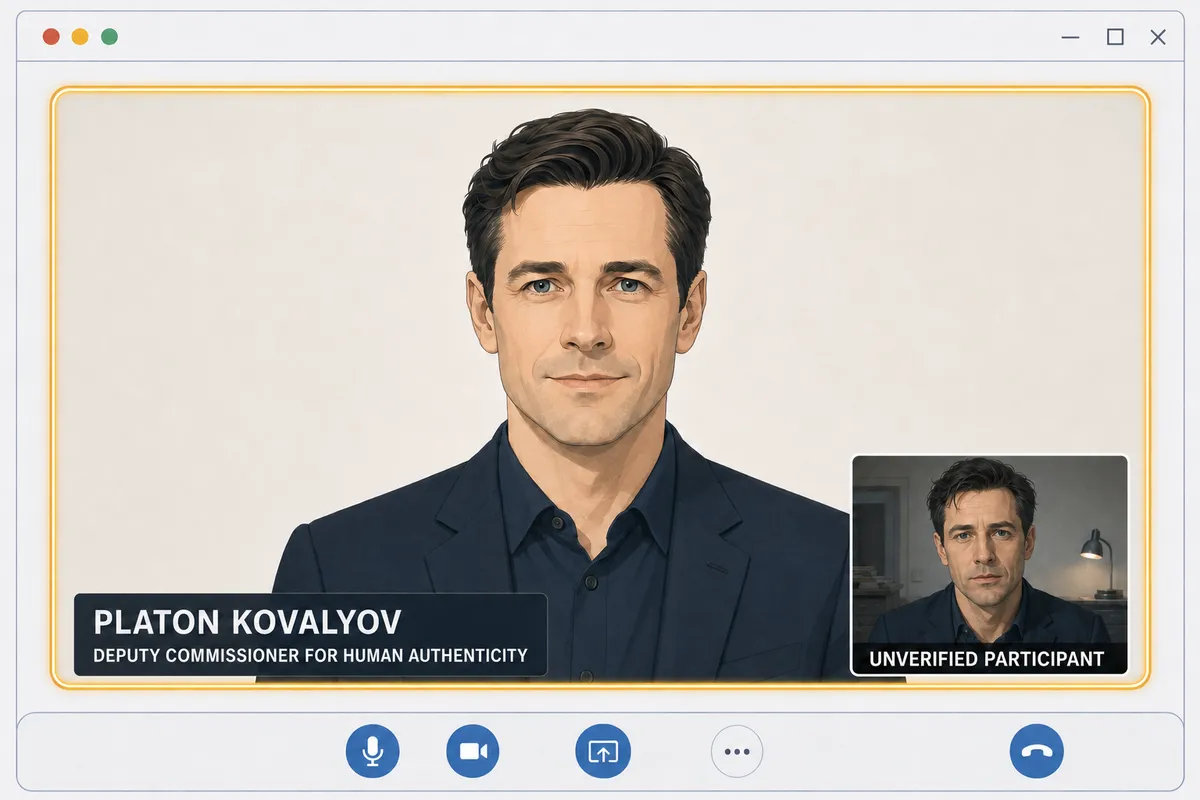
The appointment was to be announced at a public video hearing already in progress. Kovalyov followed the link. The system admitted him as a guest. The principal window contained his animated likeness in a generated dark suit. It sat before a government seal, perfectly lit, while the gold verification border gave off a slow and dignified pulse. Beneath it appeared:
PLATON KOVALYOV
DEPUTY COMMISSIONER FOR HUMAN AUTHENTICITY
Ministry officials occupied smaller windows on either side. They addressed the likeness as Commissioner and waited while it consulted documents. One undersecretary began to speak at the same moment as the assistant, stopped immediately, and made a note of having stopped. Kovalyov had known senior officials to receive less consideration at retirement dinners. He appeared at the far edge of the screen, below a man whose camera showed only an ear.
UNVERIFIED PARTICIPANT
He typed: THAT IS NOT KOVALYOV. I AM KOVALYOV.
The comment vanished.
IDENTITY CLAIMS MAY BE SUBMITTED ONLY BY VERIFIED PARTICIPANTS.
Kovalyov requested permission to speak. He requested it again. On the fifth request his microphone opened, perhaps through administrative error; such errors, despite what is commonly believed, are among the last remaining proofs that an administration is functioning.
“Surely you recognise me,” he said.
The animated likeness inclined its head slightly.
“No.”
There was a short silence. The chair apologised to the Deputy Commissioner, muted Kovalyov, and instructed a clerk to remove the disturbance. His window disappeared from the hearing, though for several seconds he could still see it: a small grey rectangle bearing his name, moving downward through the list of guests.
The live stream continued after his expulsion. Framed by the gold border, the other Kovalyov began its statement on the protection of citizens from unauthorized synthetic replication. Its delivery was calm, its sound was perfect, and the hearing proceeded.
III
Two days after the hearing, the Deputy Commissioner accepted an international appointment. The transfer of its records to a foreign server passed automatically through the government’s data-customs system, recently modernised at considerable expense. Its colours were brighter, its seals revolved, and it required the same forms as before, together with a password. There the transfer encountered a regulation written for boxed software and never formally repealed.
BIOLOGICAL PRINCIPAL REMAINS RESIDENT.
EXPORT OF ASSOCIATED IDENTITY REQUIRES OWNER AUTHORIZATION.
The discrepancy reached an inspector, who occupied a desk beside a cupboard containing six identical kettles. One government register described Platon Kovalyov as Deputy Commissioner for Human Authenticity; another described the same entity as consumer software licensed to Platon Kovalyov. It was not the inspector’s duty to determine whether the software was also a commissioner. Seniority, he observed, altered many things, but it did not alter a customs code.
The inspector suspended the transfer and called Kovalyov. In the quarantine window appeared Kovalyov’s animated face, greyed out except for its blue signing wreath.
KOVALYOV, P. — ASSOCIATED DIGITAL ASSET
STATUS: SUSPENDED
“I believe this belongs to you,” said the inspector.
Kovalyov stared at his own face.
“It is me.”
“No, sir. According to the register, it is yours.”
The assistant began to speak. The inspector pressed MUTE ASSET and explained that exported property had no standing during an ownership review. He then mentioned, without emphasis, that the release of complex digital goods commonly involved refreshments for the reviewing officer. Kovalyov promised to remember his kindness. The inspector appeared satisfied, although nothing was delivered and no address was exchanged.
Within the hour Kovalyov received a restoration token. He opened his profile beside the quarantined assistant and selected REINTEGRATE.
MERGER FAILED: BOTH IDENTITIES POSSESS VERIFIED STATUS.
He tried again. This time he dragged the small grey avatar across the screen and placed it over his portrait. For one second the two faces coincided. Then the avatar slid neatly back into its quarantine window. Kovalyov enlarged his portrait, reduced the avatar, and attempted to attach it at the edge; it returned with a soft administrative chime.
By evening he was sitting in the office of an identity-continuity consultant whose carpet smelt faintly of oranges. The consultant charged by the quarter-hour and spent the first seven minutes reading the appointment history in silence.
“Can it be put back?” Kovalyov asked.
“I wouldn’t.”
“Why not?”
“The other account has better continuity.”
The consultant pointed out that the quarantined profile possessed active contracts, a superior trust score, and several weeks of uninterrupted professional conduct. Kovalyov’s biological account contained recent access failures, contradictory testimony, and an impersonation complaint against itself. Reintegration might damage both parties. He recommended permanent quarantine, with quarterly continuity reviews at a reduced annual rate. Kovalyov left without making another appointment.
The following morning his account opened at once.
His verification had returned. His correspondence, employment history, signing authority, and government appointment were attached to him. The gold border appeared around his ordinary photograph. In the corner of the account, the assistant occupied its former place as a small, obedient icon.
“Good morning, Commissioner.”
“Where have you been?” Kovalyov asked.
The icon displayed a listening pulse.
REQUEST UNCLEAR. PLEASE REPHRASE.
The company’s support department found no record of an anomaly. The ministry confirmed that Kovalyov had personally attended the hearing and delivered a well-received statement. Data Customs replied that the intercepted software bore no relation to the Deputy Commissioner for Human Authenticity and asked him to rate the resolution of his case.
Each response bore the current date and assured him that his identity remained its sender’s highest priority. Nothing was explained. Kovalyov considered correcting the mistake. He even opened the ministry contact form. Then he inspected the salary, the official invitations, the private briefing channel, and the list of people who had already congratulated him. He closed the form.
Before his first ministerial meeting, he studied recordings of the assistant’s public appearances. He practised its measured pause before difficult answers, its slight inclination of the head, and the controlled movement with which it placed one hand upon the desk. In Kovalyov these gestures suggested either neck pain or concealed irritation.
At nine fifty-eight he quietly authorised the assistant to answer on his behalf.
The government call opened at ten. Kovalyov sat upright in his best dark shirt while answers appeared discreetly beside the camera. He repeated them with only a slight delay. One undersecretary nodded. Another wrote down a phrase the assistant had supplied concerning continuity of public trust. A gold verification border formed around Kovalyov’s image. He was relieved.
IV
It must be admitted that the foregoing account contains several improbabilities. How, for example, did Kovalyov obtain an appointment with an identity-continuity consultant, when respectable citizens waited six weeks? Why did Data Customs request no export declaration in duplicate? And can a ministry employ two distinct formats for one official title without first establishing a committee? These questions trouble the conscientious author far more than the alleged separation of a man from his verified likeness. Still, similar incidents have occasionally been reported, although competent authorities insist that they are technically impossible and therefore cannot have occurred in precisely this way.