The Best of All Possible Planets
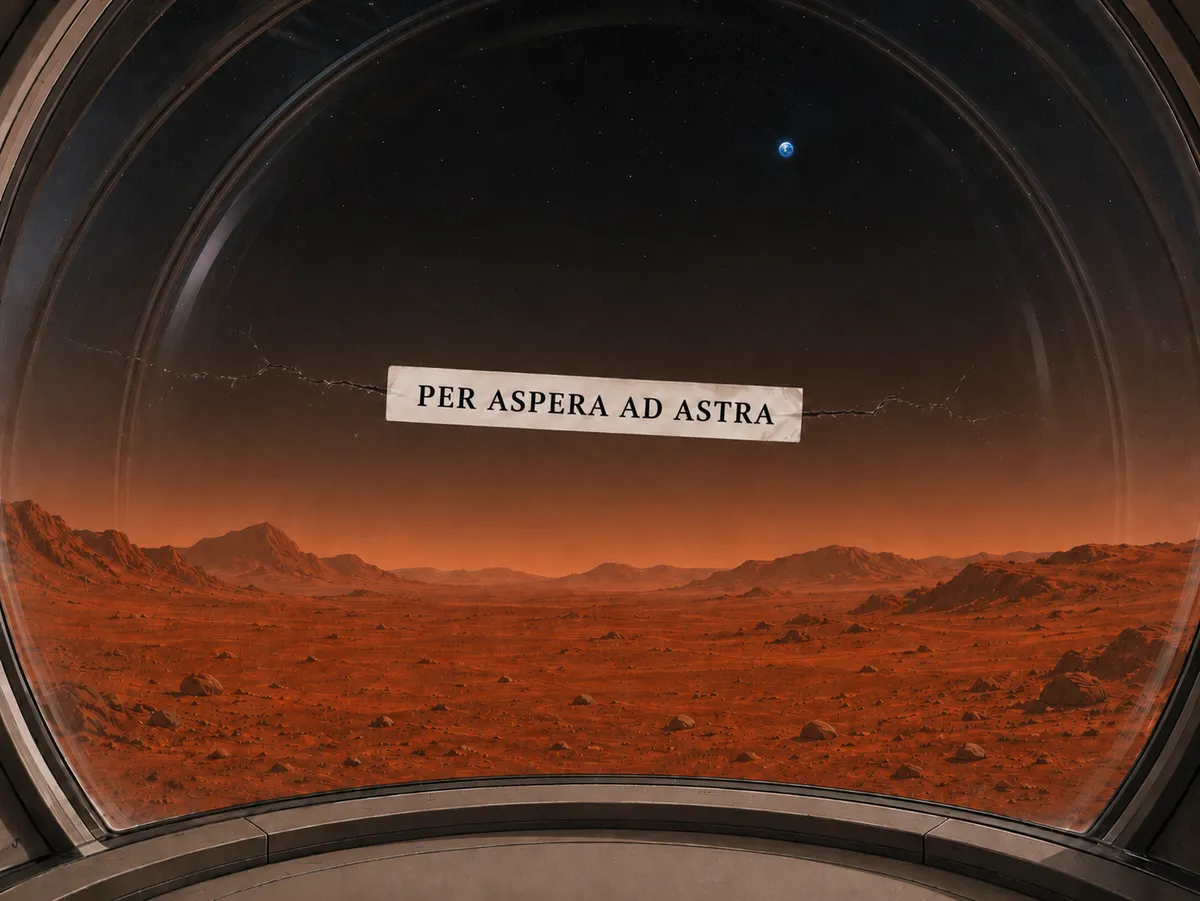
As the vessel descended upon Mars, Candide adjusted his thin black tie, which gave to his questions an air of funeral importance. Below him lay the best of all possible planets: red, bare, costly, and lacking only what men had formerly required.
Beside him sat Dr. Pangloss, professor of Exponential Providence, who regarded the desert with serenity.
“Observe,” said Pangloss, “how much wiser Mars is than Earth. Earth has air, water, trees, birds, and other inducements to idleness. Mars has none of these things, and is therefore plainly designed for the improvement of man.”
Candide asked, with his usual modesty, whether a planet without air could be called habitable.
“Planets without air,” answered Pangloss, “were made to elevate the business of breathing. On Earth a man breathes from habit; on Mars he breathes from conviction.”
The enterprise which carried them there was called Xodus, because mankind was to escape into a desert. The settlement was called New Eden, because the desert was expected to bloom after the next stock offering; failing that, the one after. The investors were not required to believe in Mars, only in its price.
Candide had once been much esteemed in the Founder’s household, for he possessed a podcast and knew how to listen to powerful men until their opinions returned to them as wisdom.
The interview lasted four hours and seventeen minutes, including several silences in which Candide found many meanings. He asked whether love might be the ultimate engine of civilisation. The Founder replied that an engine of that description was in development, and would be announced when the regulatory environment improved.
“So love must wait,” said Candide, “until civilisation is worthy of it.”
In the Founder’s garden lived Miss Cunégonde, who had beauty, wit, and very little say in the use to be made of either. She had been reserved, in the delicate language of the household, for a distinguished genetic future. Candide met her one evening among the citrus trees, where the air was sweet and belonged to no one. He spoke to her of love, civilization, and the stars. She replied that he talked too much, which he received as intimacy.
They were found behind a hedge.
The Founder, who governed most wisely by appearing at intervals, sent one word: “Concerning.”
Candide was removed from the guest list, from three advisory circles, and, by a sudden improvement in his eligibility for Xodus, from the planet. Dr. Pangloss, who had explained the matter so well that even the Founder’s household tired of wisdom, was sent with him.
“You see,” said Pangloss, as Mars swelled beneath the glass, “how admirably one word may govern several lives.”
The captain then announced that they were landing. New Eden’s spaceport rose to meet them. It had been completed in principle, lacking only those parts which prevent ships from striking it.
They struck it.
The vessel carried away a welcome arch, an oxygen kiosk, and one arm of the Founder’s statue. The arm, which had pointed toward the stars, lay pointing there still. Several colonists were hurt; a guidance tower collapsed; Pangloss lost two teeth.
The sirens called it a crash. The public channel called it an arrival experience.
Candide and Pangloss were issued pressure suits and conducted through an outer airlock into New Eden, which consisted of seven domes. Three were cracked, two were promised, one was for investors, one contained the Department of Resilience, and none contained public air.
Then the planet shook. The cracked domes shifted; pipes burst, alarms contradicted one another, and several colonists, having escaped the landing, were struck by pieces of the port.
Candide and Pangloss were hurried into the nearest dome. Its cracks had been covered with slogans, as if optimism were a sealant; across the largest ran PER ASPERA AD ASTRA. Candide saw greenhouses where the labels had prospered better than the plants and a fountain erected to the memory of water. Beyond an airlock marked FRONTIER, a road led toward the El Dorado Rare-Earth Extraction Field, where the ores remained underground but the prospectus had yielded abundantly.
In the dome's central square, the children’s lesson had already resumed. Their little helmets hissed softly as they were taught that Earth had been humanity’s infancy, and that trees, rivers, and free air had delayed the maturity of the species.
A little farther on, several colonists stood patiently before the Oxygen Office. Candide asked whether air was scarce.
“Not in principle,” said a clerk. “Only in practice. Basic Air is sufficient for reflection and light duties. Priority Air is recommended for labour, conversation, and sleep. Founder’s Breath includes fewer interruptions.”
“And those?” asked Candide, pointing to several settlers whose helmets murmured while they inhaled.
“They breathe with advertisements,” said the clerk. “It is a generous plan, for it costs them nothing but attention.”
Candide remembered the citrus trees, and wondered that he had not noticed the air before.
Beside the queue stood a man in a patched pressure suit, repairing a faulty gauge. He gave his name as Martin. Candide asked whether he also believed Mars had been wisely chosen for the improvement of man.
“No,” said Martin. “It was chosen because deserts are cheaper than apologies.”
Pangloss smiled at such a melancholy doctrine. “You mistake the provisional appearance of greatness for misfortune.”
Soon after, two guards arrived to announce that Dr. Pangloss had been summoned by the Office of Alignment. His use of the phrase “insufficiency of the port,” having survived into the public record, was reviewed as an attack on free expression, since it had made several officers less free to describe the port as complete in principle. His breathing was temporarily suspended for the duration of the review, so that the panel might deliberate without further disturbance. The public channel carried the proceedings under the title Transparency Live, earning its highest ratings of the week.
“Admirable,” said Pangloss faintly, when he returned, having been restored to the lower tier of breathing. “I perceive already that my lungs have become more efficient.”
At the same time, the Founder sent a message to New Eden. It was studied at once, since messages from Earth were easier to receive than supplies.
New Eden, he said, had entered a phase of strategic self-sufficiency. Shipments from Earth would be paused in order to accelerate independence. The next stock emission would follow when conditions were more favourable. The Department of Resilience announced that confidence remained high.
Pangloss received this news with joy.
“You see,” he said, “that dependence on Earth can only be overcome by the removal of Earth. Supplies are a prejudice of the supplied. Nothing proves the maturity of New Eden so perfectly as being left to itself.”
Candide wished to answer, but the queue before the Oxygen Office had grown longer.
He put his hand to his recorder, meaning to ask someone a grave and generous question, but its glass was cracked, and the machine gave back only a little hiss.
He then loosened his thin black tie. It had served him well among men who required listening to; it was of no use before a broken valve. Seeing a child’s helmet begin to whistle, Candide took up a spanner from the dust and asked where it was wanted.
Pangloss continued to prove that the loss of Earth was the necessary condition of independence from it. The Department of Resilience repeated, on the public channel, that confidence remained high. The content crew, finding Candide with a spanner, asked him to stand under the most photogenic crack and look hopeful.
Candide did not hear them. The child’s helmet was still whistling. He turned the valve first the wrong way, then the right, and received no applause, only breathing.
Only then did he look upward.
Through the cracked dome, above the red plain and the murmuring helmets, Earth shone in the distance. He recalled its oceans, forests, clouds, and unmetered air. He thought of the citrus trees, of Cunégonde behind the hedge, and of all the common luxuries which had not seemed luxurious while they were common.
“All that is very well,” answered Candide, “but perhaps we should have cultivated our garden.”