The River Path
When Siddhartha came again to the garden which had once belonged to Kamala, he stopped before the gate.
The old trees were still there. Their roots lifted the earth beside the path, and a warm smell of dust and fruit lay in the air. But the path had been widened and covered with pale gravel, and small signs stood beneath the branches. One pointed towards the MAIN ENTRANCE. Another read SILENCE GARDEN.
Beside the gate stood a larger sign:
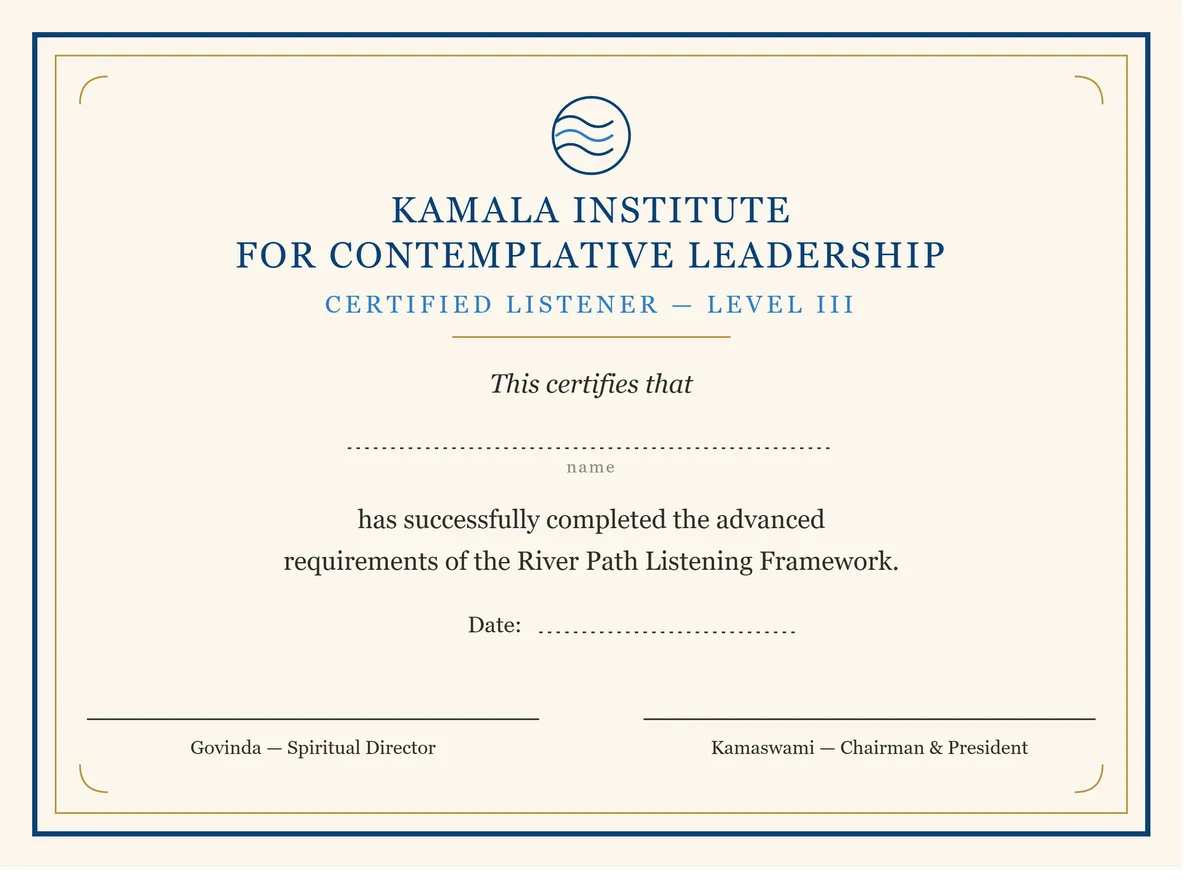
KAMALA INSTITUTE FOR CONTEMPLATIVE LEADERSHIP
Below this, in smaller letters, Siddhartha read:
THE RIVER PATH
An Authorised Framework for Non-Dual Leadership
He was still reading when Govinda came towards him.
Govinda had become very old. His shoulders were narrow, his face was covered with wrinkles, but his eyes were bright, and when he saw Siddhartha he smiled as he had smiled long ago, with love and astonishment.
“Siddhartha,” he said.
“Govinda.”
They embraced.
Behind Govinda came Kamaswami, also very old now, dressed in clean and simple clothes. His hair had become white, and he held himself as upright as age allowed, supported by a polished staff.
“You have come at the right time,” he said. “We were afraid the road might delay you.”
“I did not know there was a right time,” said Siddhartha.
Kamaswami smiled. “There usually is, once enough people have been informed of it.”
A young man wearing the plain brown clothing of the Institute came from the gatehouse. He bowed to Govinda, then to Siddhartha, and took Siddhartha’s bundle.
“I can carry this,” Siddhartha said.
“Yes,” said the young man, “but I am going inside.” He took the bundle and went ahead.
They began to walk. Between the trees stood low buildings of wood and plaster. Men and women moved quietly from one to another, carrying books or folded cloths. From somewhere beyond the wall came the sound of a bell.
“Kamaswami bought the garden when the monks could no longer maintain it,” Govinda said. “We often thought of Kamala, and of how she had given the garden to a life beyond her own. In time we founded the Institute here. I serve as Spiritual Director, and Kamaswami is chairman and chief executive.”
At the entrance to the largest building, Kamaswami opened a glass door. The air within was cool. Opposite the entrance hung a portrait of Kamala beneath a flowering tree. Beneath it was a bronze plaque:
KAMALA — PATRON, ENTREPRENEUR, SEEKER
Its final sentence read:
Her vision finds its continuing expression in the Kamala Institute for Contemplative Leadership.
Siddhartha read it twice.
“Is something wrong?” asked Govinda.
“No,” said Siddhartha. “Most of it is true.”
Kamaswami nodded. “We were careful about that.”
Along the next corridor, a painted river marked the stages of Siddhartha’s life:
ASCETIC DISCIPLINE
EDUCATION OF DESIRE
ABUNDANCE AND CRISIS
APPRENTICESHIP AT THE RIVER
“Visitors are often relieved by this,” said Kamaswami.
“By what?”
“By learning that confusion can belong to a path.”
Siddhartha looked at the painted line.
“Does a life know its stages while it is being lived?”
“Usually not.”
“Then who gives them their names?”
“We do,” said Govinda. “But only afterwards.”
Near the end of the corridor an old Samana sat upon a bench. His robe was dusty and his cheeks hollow. A woman from the Institute placed a bowl of rice in his hands. Another brought water and a folded cloth for his back. The Samana thanked neither of them. He held the bowl and stared at the rice.
No one hurried him.
Siddhartha watched for a moment.
At the end of the corridor stood two high wooden doors.
“We thought,” Govinda said, “that before you rested, you might greet a few friends.”
“A few?”
Kamaswami opened the doors. Beyond them was a great room filled with people.
Hundreds of faces turned towards Siddhartha. Men and women sat in long rows. Some wore the robes of monks; others were dressed like merchants or travellers. At the front stood a low platform. Upon it were three chairs, the middle one empty, and a table with a vessel of water.
For a moment no one spoke. Then the whole room rose in applause. Siddhartha looked at Govinda, who lowered his eyes. Kamaswami gestured towards the empty chair.
“It is yours,” he said.
When Siddhartha had taken the middle chair and the audience had sat down, Kamaswami waited until the applause had ended. “My friends,” he said, “we are honoured today by the presence of the man whose life stands at the source of our work.”
Siddhartha turned his head towards him. Kamaswami spoke without haste. He told of the Brahmin’s son who had gone to the Samanas, of the rich man who had lived in the city, and of the ferryman who had learned beside the river. “From these experiences,” he continued, “the River Path took its first form. Siddhartha himself did not establish the Institute. For this reason we do not call him its founder. We call him its Founding Source.”
Upon the wall behind him appeared:
SIDDHARTHA — FOUNDING SOURCE
The audience applauded. Siddhartha looked at Govinda, who smiled at him with uncertainty, and Kamaswami sat down.
For a little while there was silence. Siddhartha heard the rustling of paper and, beyond the high windows, the faint cry of a bird. Then a woman rose. “Master Siddhartha,” she said, “we are taught that knowledge may be communicated, but wisdom must be lived. How can a teacher help another person towards wisdom without giving him only knowledge?”
Siddhartha looked at her. “Perhaps he cannot.”
Several people bent over their papers. “What I know,” he continued, “I can tell you. But the wisdom of my life cannot become the wisdom of yours. The things which have taught me were not chosen because they were wise. Often I did not know what they were teaching me. A man cannot take another man’s errors and make from them a road which is safe.”
Govinda leaned towards him. “Yes,” he said, “this is very important.” Then he turned towards the audience. “No one is asked to repeat Siddhartha’s life. The stages do not tell a man where to go. They help him understand where he is.”
A man beside the wall began writing upon a small tablet.
Siddhartha regarded his old friend, and for a moment his face became gentle.
“You have understood much, Govinda.”
Govinda smiled.
“And how will he know whether the pattern was in his life, or whether he put it there?”
Govinda’s smile faded.
“There is no River Path.”
No pen moved. For a moment the great room was completely still. Then Kamaswami turned towards the man beside the wall. “Can we have that?” The man touched the tablet, and upon the screen appeared:
THERE IS NO RIVER PATH
Above the words was the small blue mark of the Institute, in the shape of flowing water.
Siddhartha looked at it. Govinda said, “Kamaswami, that sentence must not be separated from what Siddhartha has said.”
“Of course.” Kamaswami nodded. “We should make that clearer in the next edition.”
Questions continued. Siddhartha answered briefly, and Govinda made careful distinctions.
Then the old Samana whom Siddhartha had seen in the corridor rose from his place near the door. He stood with difficulty. “I have lived among the Samanas for thirty years,” he said. “I have fasted and learned to endure much. I believed that if I remained long enough, desire would leave me.” He looked down. “But now I desire to go home. My mother has died. My brother’s sons are grown. I have not seen my village since I was young.” He lifted his face towards Siddhartha. “I do not know whether the wish to leave is wisdom or weakness.”
Siddhartha looked at him for a long time. “Are you tired?” he asked.
“Yes.”
“Do you wish to go home?”
The Samana closed his eyes. “Yes.”
Siddhartha said nothing. At first the man stood stiffly; then his shoulders sank, and he sat down. After a while he looked towards Siddhartha again. “I am ashamed,” he said.
“Of wishing to go home?”
“Of not knowing whether I should.”
Siddhartha nodded. Outside the hall the bird called again. For some time neither man spoke, and then the Samana bowed his head. A notebook opened. Then another.
Govinda rose. “Siddhartha has not advised our friend either to remain or to leave.”
“He has preserved the Samana’s authority over his own decision,” said Kamaswami.
Govinda turned to him. “He did not preserve it for him. It was already his.” Kamaswami considered this. “Yes.”
The man beside the wall began to write.
Siddhartha rose. “You have made a teaching that cannot be contradicted,” he said. “Whatever I say becomes your agreement.”
Govinda rose also. “Siddhartha—”
“I founded nothing,” Siddhartha said. “I did not found this Institute. I do not authorise the River Path.”
“No one wishes to say that you founded the Institute,” said Govinda.
“Yet I am its Founding Source.”
Govinda looked at the words behind them.
“That term can be changed,” said Kamaswami.
Siddhartha turned towards him. “That is not what I am asking.”
“I know.”
“Then hear me plainly,” said Siddhartha. “Anyone may remember me. Govinda may tell what he remembers. You may write books about my life. You may disagree with me. But do not say that I have given my authority to this.”
Kamaswami nodded slowly. “I understand.”
Govinda looked relieved.
Then Kamaswami said, “It seems to me that this refusal is essential.”
Govinda shut his eyes.
“If the River Path depended upon your authority,” Kamaswami continued, “then it would ask people to submit to an authority outside themselves. Your refusal prevents that.”
“No,” said Govinda. “You must not use his refusal to authorise what he refuses.”
Kamaswami looked at him with attention. “Yes,” he said. He turned towards the man beside the wall. “Do not use ‘authorise’.”
The man nodded. For a moment there was silence. Then someone began to applaud. Others joined, and soon the whole hall was filled with the sound. Govinda stood beside Siddhartha with his hands hanging at his sides. Behind them, on the white screen, the words still remained:
THERE IS NO RIVER PATH
When the applause had ended, another pair of doors was opened. Beyond them lay another garden.
Siddhartha stepped outside. The afternoon light was warm, and the smell of wet earth came towards him. Between smooth banks ran a broad stream of water. It curved among young trees, passed beneath a wooden bridge, and disappeared behind a grove of bamboo. On the opposite bank stood a low pavilion of dark timber with a wide roof. Its walls were open to the air. Beyond it, farther back, began the forest.
Siddhartha stood looking at the stream. In places its banks had been faced with stone; elsewhere reeds grew close to the water.
“The old irrigation channel was enlarged,” said Kamaswami. “The water comes from the river.”
Across the stream, the audience was already crossing by the bridge. Staff members received them on the farther bank and directed them towards the pavilion. Kamaswami went with them.
Govinda touched Siddhartha's arm. “Come,” he said. “We will take the ferry.” A small boat lay tied beneath the reeds, only a short distance from the bridge. A young attendant untied it, but Govinda took the oar from him. Siddhartha stepped into the boat, and the attendant pushed them from the bank.
Govinda rowed quietly. By the time he had turned the boat into the current, several of the visitors whom they had left behind had already crossed by the bridge. Siddhartha put his hand over the side and felt the cool water against his fingers. For a little while he listened to its sound.
When they reached the farther bank, Govinda tied the boat and they walked towards the pavilion. Beside it stood a sign:
THE VASUDEVA RIVER PAVILION
“We wished to remember Vasudeva here,” Govinda said. “When he went into the forest, you remained beside the river. People continued to come to you. In this way the work went on.”
Siddhartha looked towards the forest beyond the pavilion.
They entered the building, which recalled Vasudeva’s hut in its low roof and dark timber, though its floor was smooth, its beams finely joined, and beneath the broad roof there was room for a large gathering. A long table had been prepared with books in ordered piles and vessels of pens between them. Behind it was a chair, with Siddhartha’s bundle laid beside it. The young man who had carried the bundle waited near the table, and Kamaswami was there also.
“You need not stay long,” he said. “The signing has been arranged so that people can pass through easily.”
He handed Siddhartha a book. On its cover was written:
THE RIVER PATH
Siddhartha’s Journey from Knowledge to Wisdom
Beneath the title was the blue river-mark of the Institute.
Siddhartha opened the book. The paper was thick and smooth. His childhood had become THE BRAHMIN MINDSET. Farther on he found KAMALA AND EMBODIED WISDOM, and after this THE VASUDEVA METHOD.
He turned farther and stopped.
LETTING GO OF THE SON
For a long time Siddhartha looked at the words. Govinda came beside him.
“When did I do this?” Siddhartha asked.
Govinda was silent.
“I followed him into the forest.”
“Yes.”
“I wished him to return.”
“Yes.”
“I did not let him go.”
“No.”
“He went.”
Govinda lowered his eyes. Siddhartha closed the book.
“You may remember me as you wish, Govinda. You may tell what happened as you remember it. Kamaswami may write what he wishes about my life. But this book is called authorised.”
“It will be,” said Kamaswami.
“If I sign it.”
“Yes.”
“Then it will not be.”
Siddhartha put the book upon the table.
Kamaswami looked at the pen beside it but did not offer it. A member of staff quietly moved the unsigned copy to one side.
Beneath the pavilion a line had already formed. It passed out beneath the roof, crossed the bridge and continued through the garden and into the hall.
Siddhartha turned to leave.
Kamaswami looked towards the young staff member.
“Siddhartha.”
The old man turned at the sound of his name. So did the young man. For a moment neither moved. Then the young man came towards him.
“Father,” he said.
Siddhartha looked closely at him. The boy he remembered was gone. Before him stood a man with a quiet face, dressed in the same plain brown clothing as the other workers of the Institute. His shoulders had broadened. His hands were larger than Siddhartha remembered. In the eyes he saw something of Kamala, the same direct look which did not turn away from another person.
He had last seen those eyes in the face of an angry boy disappearing into the forest. Now they belonged to a man standing calmly before him.
Govinda said, “He came to me some years ago. He has lived and worked here since.”
The young man said, “Govinda has told me about you. I am proud to be your son.”
For a little while no one spoke.
“Will you come with me?” Siddhartha asked.
“No. I live here.”
He looked towards the pavilion and the line of visitors.
Siddhartha touched his son’s arm, then let his hand fall. Kamaswami looked at the unsigned book, then at the younger Siddhartha.
“Perhaps one book,” he said. He placed a fresh copy upon the table.
The young man looked at him, then sat in the chair which had been prepared for his father. He opened the book and took up a pen.
Govinda said nothing.
The young man wrote a few words and signed:
Siddhartha
The visitor received the book. Another copy was placed upon the table. Kamaswami beckoned the next visitor forwards.
The elder Siddhartha took up his bundle and followed the path towards the forest.
Govinda went with him.
They walked together for a little while. The sounds from the pavilion grew softer behind them, and through the trees Siddhartha could still see the water moving between its banks.
At last Govinda stopped.
“You will not stay?” he asked.
“No, Govinda.”
Govinda bowed his head. Siddhartha touched his shoulder, and Govinda turned back towards the pavilion.
Before Siddhartha reached the forest, applause rose behind him.