The Whale Account
“Call me, Ishmael. Big news. Go to PACIFIC. All-hands.”
Starbuck’s message came through with the breathless neatness of something decided elsewhere. I was a junior account executive, which is to say I lived by other people’s calendars and called it my living. BLANCO had sat in my pipeline until it felt like weather, something you mention without expecting it to change.
I took my notebook, though it was only a reflex, and walked fast enough to make it look like purpose.
He picked up on the second ring, and I could hear at once that he was not in his office. There was air in the line, movement, the thin hush of a corridor.
“It’s happening,” Starbuck said.
“I’m on my way.”
“Good. Listen.” He lowered his voice, not for secrecy so much as for shame, as if the thing he was about to say ought not to exist in a place with walls. “He’s been talking about the last BLANCO deal again. The breach. That’s when his heart went. If he does it on the call, don’t correct him.”
“All right.”
“Notes only. What they ask for, what they promise, what they refuse. Let me handle the argument.”
I heard a door open, and then the hard, clean sound of the conference room came through, glass and ventilation and distant voices.
I hurried down the corridor, nodding to faces I knew and faces I only knew by Slack avatar, a crew gathered from many places and many past lives.
PACIFIC was glass on three sides, too clean to be called a room without irony. Ahab was there already, sitting very still, his hands near each other on the table, listening for something inside his own chest. Starbuck stood at one end with his laptop open, his mouth set. Stubb drifted behind him with a look that tried for ease and did not quite get there. Flask waited at the door, checking his phone, hungry for the little green dot that meant the chase was on.
In sales we call a large account a big fish. But the whale, some say, is no fish at all. I disagree: Taxonomy obeys the spreadsheet, not nature. I have read the scripture of the pipeline, and it speaks of whales as enormous fish.
BLANCO was the largest whale in our trade, the most formidable to encounter, and by far the most valuable in commerce. It drew up from under the sea that old bright oil on which the world still runs while pretending it has moved on. Its platforms stood far out past the shipping lanes, lit up through the night like small persistent cities, reaching down three miles into black water for something laid down before there were ledgers to enter it, before there was anyone to call it an asset. That was why we were gathered in PACIFIC, waiting for it to appear on the big screen in rectangles of light.
“Take notes,” Starbuck said to me, and I sat.
Ahab sat as if the chair had been bolted to the deck. His face was calm, but his attention was elsewhere. From time to time his fingers went to the left side of his chest, not tenderly, but with the impatient check a man gives a thing he did not ask for and cannot do without.
The device kept its steady time under his ribs. It was the metronome of borrowed minutes, and it made a mockery of our calendar, which pretended that half an hour could hold anything of consequence.
It had been fitted when the surface closed after BLANCO’s first breach. The paperwork held; the payment did not. The deal dissolved into “pending” and “review,” and that same week Ahab’s heart failed him. Afterwards Starbuck tried to turn us towards safer work — accounts that paid on time and asked for less of your soul. Ahab would listen, nod once, and steer us back to BLANCO as if the name were a compass point.
I opened my laptop and pulled up the BLANCO thread, not from hope but from habit. I searched the chain for the phrase we had been living on this past year.
“preferred path”
It sat there, written weeks after the breach as if nothing had happened: “You’re our preferred path. Once this is ready for production, we can talk pricing.”
We had built as if a later sentence could cancel an earlier one. Floating hulls, moorings, corrosion plans, class approvals, emergency modes. Turbines meant to stand where BLANCO’s platforms stood, meant to electrify them. But turbines weren’t the product. Reliability was. We were selling them a way to run a platform on wind without trusting luck.
Starbuck cleared his throat at the far end of the table, and the room tightened around the screen.
BLANCO arrived in rectangles. Procurement first, bright and well lit, with a smile that had been trained to mean both welcome and distance. Behind Procurement, on a white wall, BLANCO’s slogan sat in clean letters: KEEPING THE LIGHTS ON. Legal joined a moment later, tie and neutral wall, eyes already weighing risk. Finance appeared as initials with the camera off, as if money did not require a face.
“Hi everyone,” Procurement said. “Thanks for jumping on short notice. We’re excited about where this is headed.”
Her voice delivered the words with a soft finality, as if they had been read aloud before and would be read aloud again.
“We just need to make sure we’re aligned on standard terms,” she said. “Nothing unusual.”
“Standard terms” was a direction. A trade wind. Once it appeared, everything after became your deviation.
Starbuck nodded once, as if beginning a prayer, and said, “We’re aligned. Let’s go through it.”
Procurement clicked into a slide that we could not see on our end, and spoke as if reading from a document that had already been blessed.
“Given the scope here,” she said, “we’ve elevated this internally. This is being treated as mission critical. It will sit under our Strategic Supplier program, with the offshore safety and continuity group involved.”
The words should have sounded like trouble. In the moment they sounded like selection.
For a year we had lived in the half light of pilots and “exploration,” always nearly real. Now BLANCO was naming us in the language it reserved for things it meant to keep close. I felt, against my better judgment, a small loosening in the chest, the body’s foolish relief at being recognized.
Starbuck leaned forward, careful to keep his voice grateful and firm, the way you speak to a large animal that has turned its head toward you.
“That’s good to hear,” he said. “If we’re strategic, then we should be able to close on the commercial this week. We can’t stay in pilot terms.”
“Totally,” Procurement said, pleasant as ever. “And we want to move quickly. This process is just standard for critical infrastructure.”
She smiled again, and the smile did not change.
Legal cleared his throat, a small sound that carried the weight of a door closing.
“For mission-critical classification,” he said, “the default is alignment to our continuity standard.”
He glanced down, as if reading from approved text.
“It’s straightforward,” he went on. “The standard requires a transferable, perpetual license to the control software and design documentation, including the right to modify and create derivative works, and to sublicense those rights to our affiliates and contractors for operation and support.”
There was a pause in which the sentence struck the table like a fluke, flat and final.
“And,” he added evenly, “we require step in rights. If you fail to perform, a replacement operator must be able to assume control without interruption. Any custom deliverables created for BLANCO will be owned by BLANCO.”
The word “custom” was said with a careful innocence. In our draft it meant a small set of integrations and reports. In his mouth it became a solvent, spreading until it covered everything that made us a company.
Procurement nodded steadily. “This is just how we do it for offshore,” she said with a reassuring cadence. “Safety, continuity. Nothing personal. Just standard.”
Starbuck went pale, but kept his face perfectly still.
“That would let you take the product,” he said.
Legal’s expression remained neutral. “It would let us operate without vendor dependency,” he replied. “This isn’t negotiable — it’s the continuity template. It’s against policy to stay tied to a single supplier in offshore operations.”
For a moment nobody spoke. The call went very still, the way a room does when it has heard something it cannot pretend not to have heard.
Ahab’s hands were flat on the table. When he lifted his head his eyes had that bright, scornful look that seems, at first glance, like triumph.
“You asked us to build it,” he said. “We built it. Now you want to own it.” Procurement’s smile tightened and settled. Legal watched as if taking a note. Finance’s rectangle remained dark and muted.
Ahab leaned closer to the camera, as if the screen were something he could cross by force of will. His voice rose, then steadied, then rose again.
Starbuck rose a fraction from his chair, then sat again, as if even standing would be a kind of mutiny. He reached out, not touching Ahab, but near enough that the gesture could have become one.
“Not on the call,” he murmured. “Not like this.”
Ahab’s frown deepened, and he went on as though the words had been dropped into the sea.
“A year ago,” he said, “you breached.” He lingered for a second on the verb. “You broke my heart, and you called it policy.”
There was a silence that felt, absurdly, like waiting for a reply from the weather.
“This isn’t fairness,” he went on. “It’s scale. And scale gets to name itself standard because it can.”
On the big screen their faces remained pleasant and arranged. Ahab leaned into the camera, staring into it with scorched intensity, his knuckles whitening on the table’s edge.
“From hell’s heart I—” His hand went to his chest. “From—”
He tried to smile and couldn’t. “From... here.”
“I...”
The room waited for the rest, and did not get it. His face changed, not with thought but with weather. His hand tightened. For a moment he sat very straight, as if offended by his own body, and then the body took back its authority. He made a small sound, half breath, half disbelief, and folded forward.
Starbuck was up at once, chair rolling behind him. Stubb swore under his breath and reached for his phone. Flask stood as if pinned.
On the big screen BLANCO stayed in their rectangles, watching with the careful stillness of people who do not know what they are permitted to do. “Should we,” Procurement began, then stopped. Her smile was gone, replaced by that bright corporate concern that cannot find purchase on a human emergency. “We can reschedule,” she said, and the phrase fell into the room like a wrong document. “Are we recording? Should we end the recording?”
Ahab did not answer. The call continued. I found my hand still taking notes, as if habit could keep us afloat.
After Ahab died, the company did not break apart. It simply filled, quietly, and went under.
There were emails with subject lines that tried to be calm: RUNWAY UPDATE, TRANSITION PLAN, NEXT STEPS, ACTION REQUIRED. There were counsel calls in which words like exposure and duty replaced nicer ones. There was a board meeting held over video in which grief arrived as a square and left again without remark.
The layoffs were scheduled in blocks, as if sorrow could be made efficient.
Contracts were reviewed, accounts were closed, equipment was inventoried. The turbines, the hulls, the moorings, the months of salt and weather windows, all of it was reduced to line items, and then to write-offs. People carried boxes to cars and shook hands in hallways, speaking softly about “what’s next,” while the building stayed bright and indifferent, and the calendar kept opening its little blue squares for meetings that would never happen.
I survived in the small way a junior account executive can survive. I gave my account of what had happened and put it into a format that could be shared.
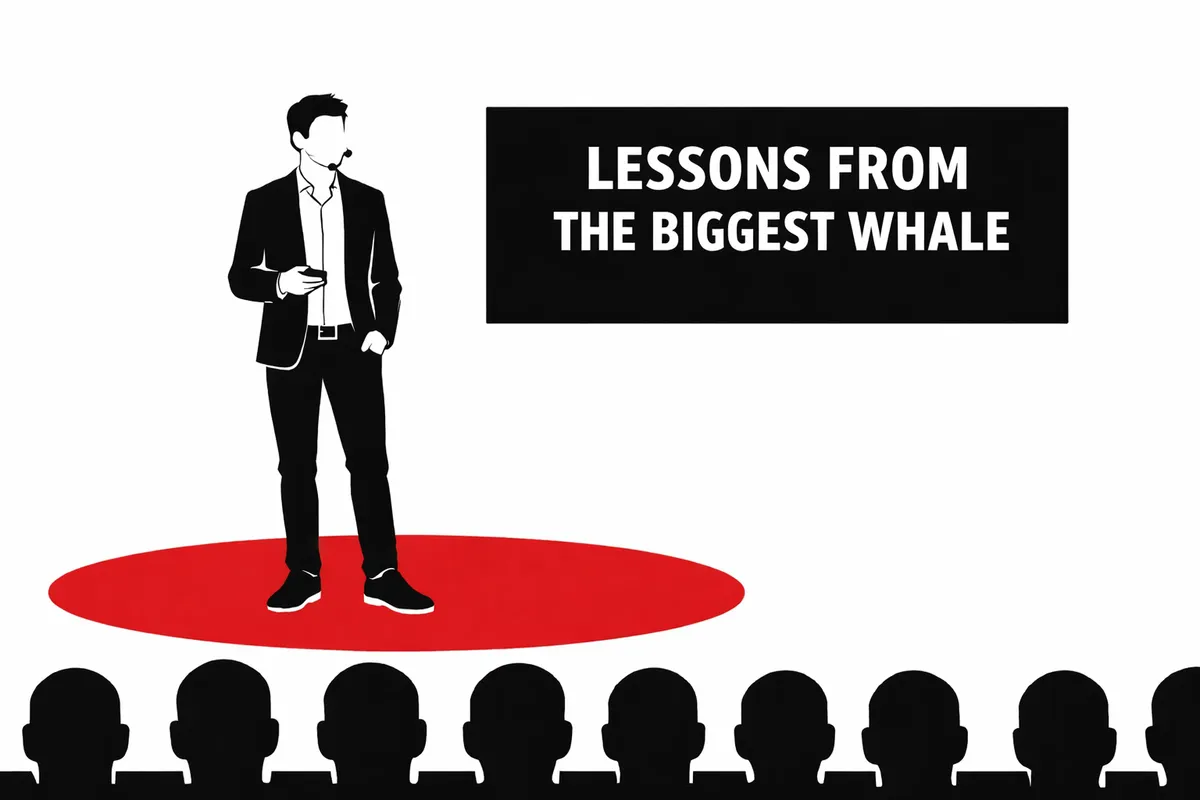
First it was a viral post, then a podcast interview, then a talk. I stood on a red circle with a clicker in my hand and a headset mic curving along one cheek. Behind me a slide declared, in bold sans-serif: LESSONS FROM THE BIGGEST WHALE.
I told it as a story of diligence and risk. I turned the year into a timeline and the breach into a bullet point. I offered takeaways. People laughed where the deck had been thin enough to sound like comedy. They nodded at the clean ending and applauded, as if applause were rescue.
On my laptop I kept another version that I did not show. At the bottom, without a heading, I had written one line and left it there like a stain:
Scale renames itself standard, and the rest goes under.
Outside the venue the city kept its commerce. The calendar filled itself again. The sea rolled on.